
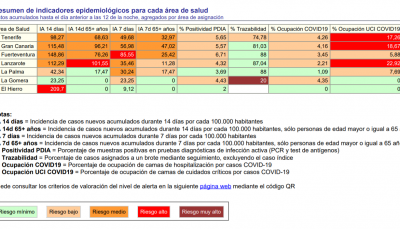
Lanzarote has been the only island in the Canary Islands that has been at alert level 4 and is the only one that continues to be currently on alert 3, but the turnaround in the figures, especially in the last two weeks, has now placed it as the island with the lowest incidence of Covid-19 in the province. In fact, in the indicators for the last week, it is the fourth island with the best data in all of the Canary Islands.
Regarding the accumulated incidence at 7 days, it stands this Wednesday at 35.46 new cases per 100,000 inhabitants ("medium risk"), while in Fuerteventura it is at 85.55 ("high risk"), in Gran Canaria at 56.98 and in Tenerife at 49.68. The last two are currently at alert level 2, which is the one that would correspond to that incidence, while Fuerteventura remains at level 1.
What the island of Majorera does not yet have is a high level of hospital pressure, which is the other indicator that is taken into account to raise the alert level. The occupation in the ICU with Covid patients is this Wednesday in Fuerteventura at 5.88% of the available beds (corresponding to "low risk"), while in Lanzarote it is at 22.92%, in Gran Canaria at 18.67% and in Tenerife at 17.26%, that is, all in "high risk" (equivalent to alert level 3).
However, the rebound in cases that is occurring in recent days on the island of Majorera has already begun to be noticed in hospitalizations, and if the trend continues, it could continue to grow. In Lanzarote, on the other hand, is now on the reverse path. That indicator shot up between the end of January and the beginning of February, and has remained at high risk due to the length of time that seriously ill patients remain hospitalized, but the trend has been downward for days. In fact, it has already left the "very high risk" in which it was for weeks.
Regarding the occupation of beds on the ward, the decrease has been much more pronounced and this Wednesday it stands at 2.21% in Lanzarote, again with one of the best data in the Canary Islands. Only La Palma and El Hierro are below.
The incidence in the elderly decreases to "low risk" in the last week
The other indicator that has been of particular concern in the third wave in Lanzarote has been the incidence in people over 65 years of age, which had been significantly reduced, but at the beginning of last week suffered a peak of a few days. However, it has now fallen again and in the last seven days is at "low risk", with 11.28 cases per 100,000 inhabitants of that age group. Gran Canaria multiplies that figure by four (47.02), Tenerife triples it (32.97) and Fuerteventura doubles it (25.42).
As for the incidence at 14 days, Lanzarote continues to drag the data from two weeks ago, so the figures are still larger. Regarding the cases in people over 65, it stands at 101.55 and still at "high risk" and above the rest of the islands; while in the overall incidence it is at 112.29 ("medium risk"), below Fuerteventura (148.86) and Gran Canaria (115.48), but not Tenerife (98.27).
The other two indicators that are taken into account, traceability (the percentage of cases that are associated with an outbreak and therefore determine its origin) and positivity (the percentage that tests positive for each test performed), are also in Lanzarote better than in most of the islands. Traceability is this Monday at 87.4% ("minimum risk") and positivity at 4.32% ("low risk").
Thus, of the eight indicators that are analyzed to establish the alert level, Lanzarote has none at maximum risk (which would be equivalent to alert 4) and only two at high risk (equivalent to alert 3). Of the rest, two are at medium risk (alert 2), three at low risk (alert 1) and one at minimum risk (new normal).
According to the criteria established months ago in the Interterritorial Council of Health, to establish a certain level of alert there must be at least three indicators in that risk range, one of them being related to hospital pressure. And this means that if the current figures are maintained, Lanzarote should soon abandon alert 3. The next review should take place this Thursday, coinciding with the Canary Islands Government Council. However, given that it was not until this Tuesday that Lanzarote dropped from alert 4 to alert 3, it will depend on the regional Executive to decide whether to keep the island for one more week at the current level until confirming that the trend is consolidated, or whether to adopt that change already.
Cases by municipalities
If something has also characterized this third wave in Lanzarote is that the cases skyrocketed in all municipalities, practically without exception. However, in the accumulated incidence in the last seven days, four are already at low risk (Tías, Teguise, Haría and Tinajo) and one at minimum risk (San Bartolomé). For their part, Arrecife and Yaiza remain at medium risk, which would be equivalent to alert level 2.
In the capital, the incidence at 7 days stands this Wednesday at 52.39 new cases per 100,000 inhabitants, when it was a few weeks ago above 500. For its part, in Yaiza it is at 30.17. In addition, in six municipalities no cases have been detected in the elderly in the last week, and the few diagnosed are concentrated in Arrecife.
As for the total cases of the last 7 days, Arrecife has added 33; Yaiza, Teguise and Tías 5; and San Bartolomé, Tinajo and Haría only one.


