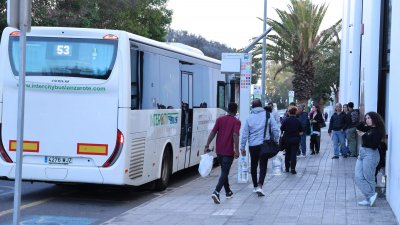
37.4% of users of the Canary Resident Bonus in the non-capital islands and 30.3% in the archipelago as a whole have given up their cars and incorporated public transport into their daily routine.
The data was presented by the Minister of Public Works, Housing, and Mobility of the Government of the Canary Islands, Pablo Rodríguez, along with the Director General of Transport and Mobility, María Fernández.
The counselor and the director have highlighted that the measure "has changed the way people move around the Canary Islands, has driven a significant abandonment of private vehicles, and has decisively expanded access to employment, education, and essential services".
Furthermore, as they reported, **one in four** users surveyed admits that **they have started using public transport after it became free**.
Citizens have also shown their support for free access, with more than 92.9% defending its continuation in the future, highlighting the importance of maintaining the measure as it currently functions.
Likewise, Fernández has insisted that the free service has facilitated **access to employment, studies, and daily errands** for 95% of users, consolidating itself as a tool that has improved real mobility opportunities in the Canary Islands and "has made it easier for Canarians to access medical treatments, jobs, and studies that they previously rejected."In addition, 82% have alluded to a significant economic saving, especially young people, students, and working individuals
Average of 16 weekly trips
The study reflects that users make an average of 16 weekly trips, which has confirmed intensive and functional use of the service and that women are the main users; furthermore, four out of five users have been using the buses for more than two years as loyal and recurring customers.
The Ministry continues to reinforce the measure with investments from Next Generation Funds for the modernization of transport with new fleet, interchanges, smart stops, charging points, and strategic projects such as the Mobility Control Center in Gran Canaria or the BUS-VAO Lane on the TF-5.
To conclude, both representatives have insisted that "for the free service to remain a success, it depends on stable and sufficient state funding, given that the measure represents a great effort for the island councils, whose investment capacity is limited if the State Government does not pay the amounts in a timely manner".
"When free services are adequately funded, citizens win, and the Canary Islands are demonstrating that well-designed public policies generate equal opportunities and contribute to transforming mobility in the Islands," they pointed out



Add La Voz de Lanzarote as a preferred Google source.
Stay informed with the latest current news.