
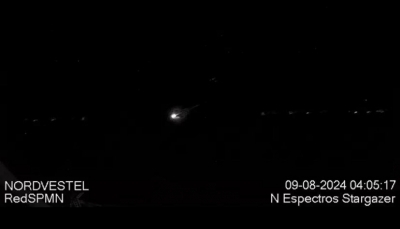
Astronomer Ramón López has managed to capture with his camera the passage of The Perseids or Tears of San Lorenzo through the skies of Lanzarote. He was also able to portray how the Delta Aquariids tinged the island's skies with light last July.
Through his profile on the social network X (formerly Twitter), Ramón López regularly shares the astronomical phenomena of the Canary Islands skies. From bolides that fly over Morocco to others that do so over Gran Canaria.
On this occasion, and meeting with the summer meteor shower, López has managed to capture from Playa Blanca the passage of the Perseids from last July to the present.
This meteor shower began to be seen from July 17 and can be observed until August 24. However, it was on Sunday the 11th and Tuesday the 13th of August when this phenomenon reached its maximum activity.
GREAT PERSEID #SPMN090824L OFF THE NORTH COAST OF #LANZAROTE TODAY at 4h05m16s TUC. The emission spectrum obtained by Ramón López @StargazerLzt from Playa Blanca, shows lines of Ca, Fe, Mg and a luminous final flare with abundant Na😍🌈
— Red Investigación Bólidos y Meteoritos (SPMN) (@RedSpmn) August 9, 2024
🔖 https://t.co/dyrGf8tuXZ pic.twitter.com/SjYauPhOa9
This 2024, the peak was August 12, between 2:00 p.m. and 5:00 p.m., coinciding with the first quarter of the Moon, so the National Geographic Institute warned that it was not a good year for its observation.
However, during the early morning of last Sunday to Monday, the one with the greatest activity of these stars, at about 05:32 hours of the night, Ramón López managed to record the passage of the bolide SPMN120824T, which could be observed from the Canary Islands, Western Sahara and Morocco. This observation has been published by the Space Sciences Institute of the Higher Council for Scientific Research.
The Delta Aquariids that said goodbye to July
According to the National Geographic Institute, the Delta Aquariids reached their maximum potential in the early morning of July 31, coinciding with the Perseids.
GREAT NORTH DELTA AQUARID #SPMN200724D OFF THE NORTH COAST OF #LANZAROTE TODAY at 2h14m25s TUC. Ramón López @StargazerLzt captured it with the order 1 of its emission spectrum from Playa Blanca, Yaiza. Passes to the updated list from @ice_csic:🤩☄️
— Red Investigación Bólidos y Meteoritos (SPMN) (@RedSpmn) July 20, 2024
🔖https://t.co/dyrGf8tuXZ pic.twitter.com/ruBjdgaMAD


