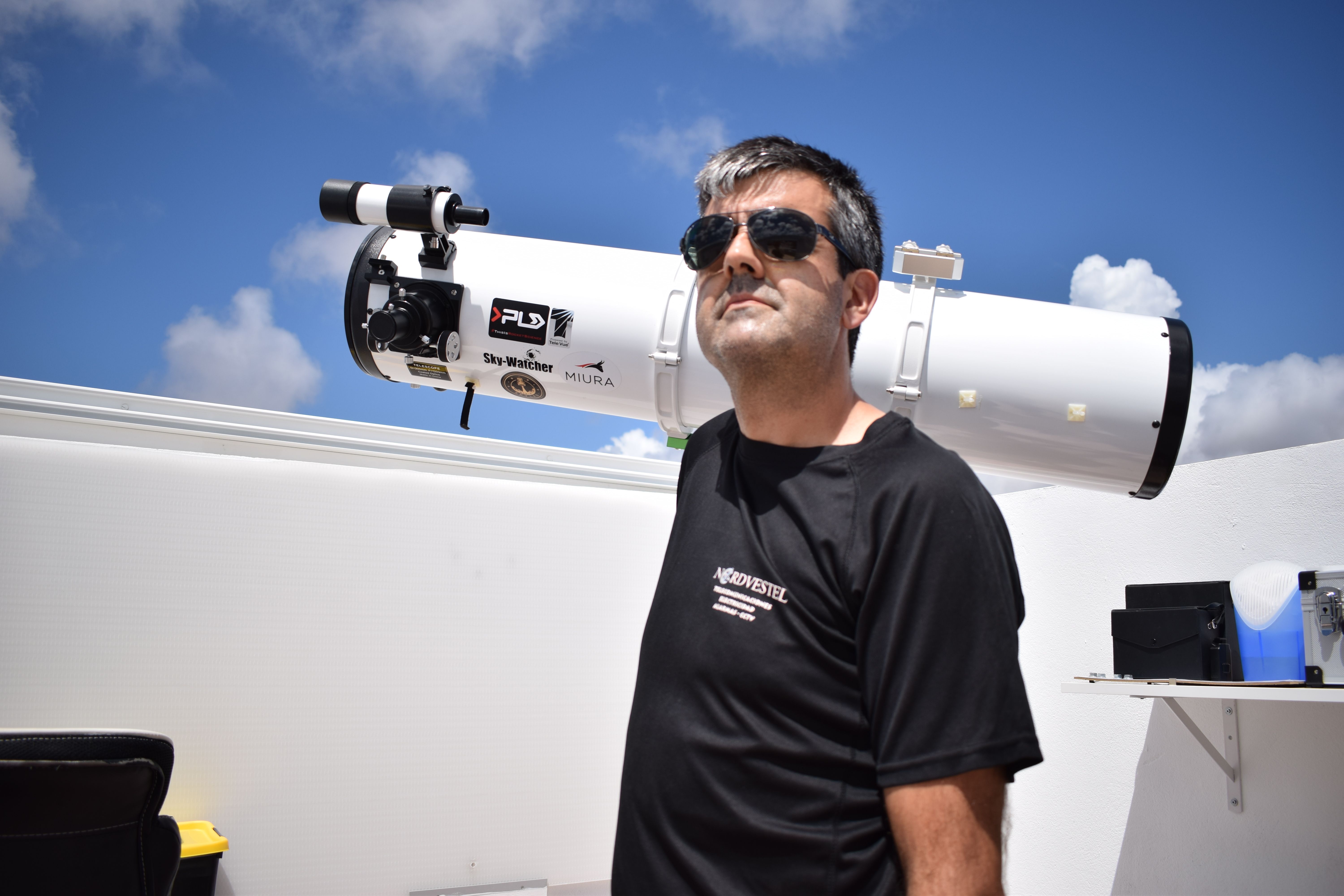
During the night of last Wednesday, October 12 to Thursday, October 13, two bolides surprised those who were looking at the sky of Lanzarote, at 20:06 and 00:28. These celestial bodies, heading towards Mauritania and Morocco, were detected by Ramón López, an astronomer collaborating with the Bolides and Meteorites Research Network (SPMN) and owner of the Playa Blanca video-detection station.
López says that during the morning of Thursday he was checking the cameras, as he does at the beginning of each day, when he spotted these two objects: "I saw that they were of considerable size and I notified the Network so that they could disseminate them".
However, the observer indicates that this finding is not at all strange, since "every night we have events, whenever the sky is clear something is captured", so the passage of bolides like these throughout the Spanish territory is common.
In addition, it is not unusual that they have been seen so clearly from Lanzarote: "Here we are privileged because we have more clear days than in other places, which makes it even easier to spot them."
To determine that a body is a bolide, the size of the planet Venus is taken as a reference, whose magnitude is equivalent to -4 in astronomical levels. One of the two sighted in Lanzarote on the days mentioned reached -14.
"Almost everyone has seen a shooting star on some occasion. These are remains left by comets or asteroids in their journey around the sun, they cross the Earth's orbit and leave a trail of small rocks. When these rocks are equal to or larger than Venus, we speak of bolides", explains López. In this same context, when the stones reach the Earth and touch the ground, they are considered meteorites.
Are bolides dangerous?
Despite their frequency, these celestial objects do not normally pose any danger, since "they can reach up to half a meter, but they usually disintegrate in the atmosphere".
Despite this, the amateur astronomer warns that "it is important to keep your eyes on the sky" and recalls the Cheliabinsk bolide, which impacted Russia in February 2013: "It entered unexpectedly, we did not detect it with cameras or radars. It surpassed the atmosphere, touched the ground and its shock wave caused injuries and material damage."
This is explained by the fact that objects of meters in diameter are, "practically 100%", controlled through satellites, telescopes and radars; while those that are smaller, although with a considerable magnitude, are more difficult to visualize and could put certain population centers on alert.
For example, "if a bolide like the one in Cheliabinsk, which was a hundred meters, fell in the center of Playa Blanca, it would destroy everything", compares López.
"I have not seen absolutely anything that I have not been able to identify"
And it is precisely in this coastal nucleus where the observer has installed his station for about five years, which has seven cameras: two that collect information from the entire sky, four that sectorize it according to the cardinal points and one that looks north and determines the chemical composition of the bolides.
This space in Playa Blanca, together with two others located in La Palma -one in the Gran Telescopio Canarias (GRANTECAN) and another in the Telescopio Nazionale Galileo- are part of the SPMN. In addition, the professional also transmits his research through his social networks.
During these years looking up, the astronomer declares that he has not seen surprising elements: "There is absolutely nothing that I have not been able to identify."
What there is is a more special sighting than the previous ones, during last March 2021, when he detected the first bolide collected in a double place. "It was the first one that was seen in the Canary Islands in two stations, mine and the GRANTECAN's. It does not represent the most intense or the most beautiful that I have seen, but it is the first and therefore the most special", he says.
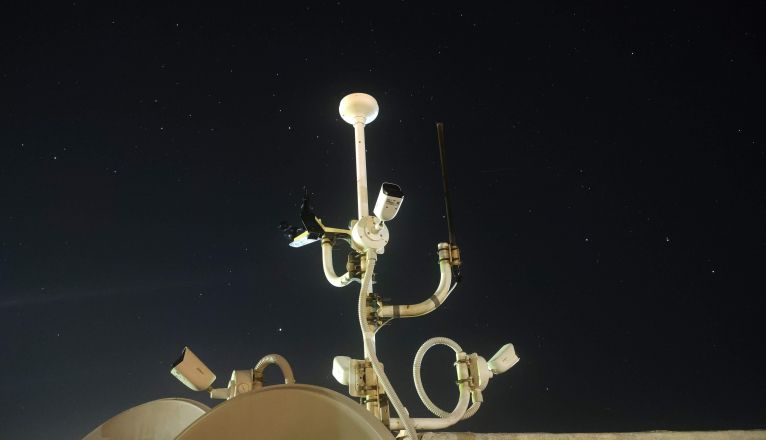
Playa Blanca bolide station. Source: Ramón López
The end of the world... Stays in the movies
Deep Impact (1998), Melancholia (2011), Greenland (2020) or one of the most recent and lauded productions within the apocalyptic genre, Don't Look Up (2021), are some of the films that collect near futures where an asteroid impacts against the Earth and the end of the world occurs.
López, although he does not rule out the possibility that fiction may cross over into reality, affirms that the hecatomb could be avoided: "We can detect with decades, and even centuries in advance, the arrival of an asteroid that causes a global catastrophe".
Beyond this, the astronomer indicates that technology is currently beginning to be tested that would also allow "to divert the bolide with time", so he calls it "difficult" that a global event of these characteristics would catch us off guard.


Add La Voz de Lanzarote as a preferred Google source.
Stay informed with the latest current news.