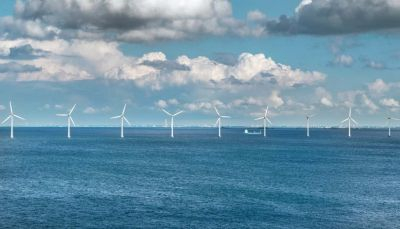
The Minister of Ecological Transition of the Government of the Canary Islands, José Antonio Valbuena, stated this Friday that the islands are one of the regions with the greatest potential at a regional and European level for the implementation of offshore wind initiatives.
Valbuena made these statements at the dissemination conference “Offshore Wind in the Canary Islands, an opportunity for growth”, organized by Puertos de Tenerife and the Business Association Eólica (AEE) and developed at the facilities of the Oceanographic Institute of the Canary Islands (IEO), as reported by the Port Authority in a statement.
"The deployment of this type of wind energy would allow us to move firmly towards energy self-sufficiency and reduce our current dependence on fossil fuels, also generating new job niches that are opening up with the implementation of renewables in the coming years,” said the counselor.
Carlos González, president of the Port Authority of Santa Cruz de Tenerife, also spoke at the conference; and Tomás Ramagosa, technical director of the Business Association Eólica. The first has influenced the leading role to be played by the port of Granadilla in offshore wind, being the first in Spain to process a park of these characteristics.
Currently in environmental processing, it will reach 50 megawatts, with fixed foundations, made up of five wind turbines in depths of between 15 and 50 meters and will occupy approximately 630,000 square meters of port waters.
For the deployment of offshore wind energy in the Canary Islands, the port of Granadilla will have a land area of 24 hectares, without forgetting other initiatives such as the installation of floating photovoltaics in the southern mouth of the port of Granadilla and the use of the new dock as experimentation to obtain energy from the waves, he added.
For Tomás Ramogosa, offshore wind is at a key moment to start its definitive development in Spain.
"While other countries around us have already started their first development processes for floating wind farms, Spain must still implement a set of measures and adapt its regulations without wasting time," he said.
In his opinion, one of the keys is to approve the Maritime Space Management Plans, identifying sufficient wind areas in the locations of the coasts that have good wind resources and acceptable depths, preferably below 200 meters.
This will allow the development of efficient projects, capable of generating renewable electrical energy, with high capacity factors and at reasonable costs, he added.
The Canary Islands is one of the regions with the greatest potential for offshore wind
Wind energy is a great step towards energy self-sufficiency, as it would reduce dependence on fossil fuels
April 25 2022 (12:02 WEST)
Updated in
April 25 2022 (12:08 WEST)