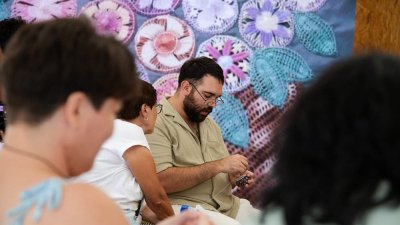
Canarian tradition and identity, whether represented through art, landscape, history, or gastronomy, represent a treasure that must be continuously protected and disseminated. Canarian rosettes are one of the jewels the islands possess. They are a type of lace that developed in the Canary Islands in the 19th and early 20th centuries, crafted by artisans who turned precision, passion, and talent into a unique piece, stitch by stitch.
Samuel Ramos (Montaña Blanca, 1999) is one of the faces of the new generations from Lanzarote who are committed to keeping this tradition alive. In an interview with La Voz, he presents his project Roseta Siliadora, with which he aims to continue a cultural and artistic legacy through handmade earrings.
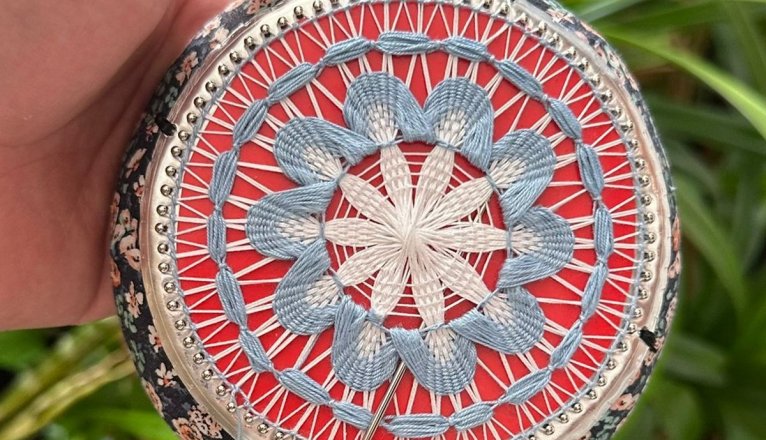
According to his explanation, rosettes are a type of lace "that we inherited from our ancestors, which is made on a cushion, and **there is a difference between those made in Tenerife and those made in Lanzarote**".In this regard, it highlights that in Lanzarote a steel sheet is used where the holes are made to place the pins, while in Tenerife leather is used
A beginning marked by family heritage
Ramos recounts that he began to delve into the world of rosettes after being gifted one over a year ago. "Back home, my mother explained to me what rosettes were and how they were made, so that's where I started to learn about my family's history, as my great-grandmother María Auxiliadora used to make them and taught my aunt and mother how to make them," he recalls.
Both his great-grandmother and his grandmother were in charge of making the rosettes with white thread, as it was the one that required the most care to avoid staining it. "Both my aunt and my mother had to make them in beige because they didn't have as much care as they did," he explains.
Thanks to learning this art through his family, the young man decided to enroll in a rosette workshop to make earrings until he learned how to make them and continued at home.
His beginnings were also driven by the support he received on social media when he showcased his creations. "When you see that out of the 500 people who see your post, a hundred of them like it and comment, I realized that my followers were interested in rosettes," he says.
From there, she decided to create a profile dedicated to it," she explains, and what she did was give them to her family on their birthdays. "To one of my aunts, I gave her earrings with the card and the logo, which is my great-grandmother sitting on a bench making a rosette," she recalls.
Making the rosettes
Regarding its difficulty, Ramos describes his process as "a blank slate, you don't know where to start but I let myself go, after all it's about passing a needle through the threads and making knots... I let my imagination run wild and there are days when I'm more inspired and try something new, but other times I do the typical rosette."In this regard, he points out that "meeting other artisans helps you discover other rosettes you haven't made and try to recreate them on your own." Some of the rosettes have specific names, but others are **invented**. "They taught me one that is a palm tree and it's very beautiful, but it wasn't made in ancient times," he says.
This element is made with thread, although it must have a certain thickness and be of good quality, as otherwise the thread would fray in the process. Anyone who wants to place an order with Samuel Ramos can do so through his Instagram profile, where the rosette maker will send them the models he makes
Rosettes are a type of lace that can be incorporated into various garments. "They are usually used in all kinds of cloths, tablecloths, placemats, and other household items, but also in clothing such as aprons or shirts," she states.
He also highlights that Antonio Betancor, a rosette artisan from Haría, is one of his role models. "He's brought rosettes into fashion, he's made an entire suit with them or bags... right now, the rosette is booming in the world of fashion," he points out. Ramos emphasizes that "social media can make the rosette active again in the Canary Islands."
The need for greater ease from institutions
The rose grower emphasizes that "greater ease should be given to becoming an artisan and being able to create." "In my case, I cannot submit the documentation until March, and even then I am afraid because I will not be able to be one, as I do not meet the requirements... I cannot present you with an invoice from more than a year ago when what I mainly need is a degree to sell or go to a fair," he criticizes.
"I am not self-employed and a young person cannot afford to register as self-employed and wait a year for a permit," he continues. He also highlights that in his municipality, San Bartolomé, "I have seen the list of artisans and there are none who make rosettes, and in that sense, I feel sorry because I could be the first, but I don't know if I will be able to be."



Add La Voz de Lanzarote as a preferred Google source.
Stay informed with the latest current news.