
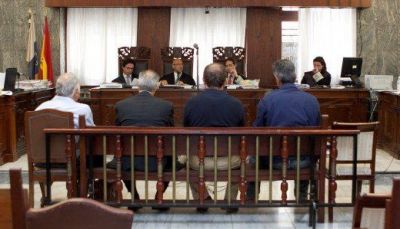
The Supreme Court has rejected the appeal filed by the former surveyor of Yaiza, Pablo Carrasco, who sued the City Council twice, after being removed from his position as a result of a court conviction. In the sentence issued in 2011 by the Provincial Court, and ratified in 2013 by the Supreme Court, Carrasco was sentenced to a five-year disqualification for a continuous crime against land planning, together with who was then secretary of Yaiza, Vicente Bartolomé Fuentes.
After the final judgment arrived, the City Council raised a query to the Provincial Court, which confirmed that the worker had been sentenced to "five years of special disqualification for employment or public office related to the commission of the crime (member of the Technical Office of a City Council)". For this reason, a municipal decree was issued declaring the loss of his status as a technical architect and ordering his dismissal from those functions. At the same time, he was "provisionally" suspended as an employee, pending resolution of other "consultations" that the City Council had carried out, as stated in that resolution.
As a result of this decree, Pablo Carrasco first filed an appeal with the City Council itself, which was rejected, and then another in the courts. In that lawsuit, he claimed that he performed "other functions different from those of technical architect for which he has been judicially disqualified" in the City Council. Therefore, he defended his right to continue developing those "other" functions and to recover his "work activity" in the City Council.
The first lawsuit, "dismissed outright"
The Social Court number 3 of Arrecife already "dismissed outright" that first lawsuit in a judgment issued in April 2014. The ruling, in addition to the conviction itself, referred to the clarification made by the court itself, which responded to the City Council's query making it clear that this disqualification penalty "definitively deprives the convicted person of the employment obtained to perform the function in which he committed the crime, even if he is not an official and is permanent staff", as was his case.
Regarding the possibility of performing other functions in the City Council, the judgment responded that it was not the object of that lawsuit to determine whether or not he could be hired for another position. However, it made it clear that in any case it would be a new hiring by the City Council, having lost the rights to his previous position, which is "in which he committed the crime".
Carrasco did not appeal that judgment, which is therefore final, but he did file a second lawsuit. In it, he claimed that the City Council should pay him all the salaries he had stopped receiving since he was removed from his position in the summer of 2013. "What is intended here lacks support," concluded the judgment that resolved that second lawsuit, in July 2015, concluding that the case had already been judged in the first procedure.
Against that ruling, issued by the Social Court Number 1 of Arrecife, Pablo Carrasco did file an appeal with the Social Chamber of the Superior Court of Justice of the Canary Islands, which is the one that has now been rejected. According to this latest judgment, Pablo Carrasco had the status of indefinite worker and a monthly salary of 3,426 euros as a technical architect of the Technical Office of Yaiza.
Investigated in other cases and accused in Stratvs
In addition to this conviction that removed him from his position, Carrasco also had another in the first instance, although it was later annulled due to an error in the wording of the "legal foundations" of the judgment, where what had been stated in the proven facts was not clearly reflected. To this are added other cases in which he has been investigated and, above all, his accusation in the Stratvs case. In that procedure, the Prosecutor's Office is asking for 5 years in prison and 24 years of disqualification, given that on two occasions he favorably reported the granting of licenses to that illegal winery.
Regarding the conviction that led to his disqualification, the Court considered it proven that both he and Vicente Bartolomé Fuentes issued favorable reports for the construction of nine chalets located on a plot between Las Breñas and Femés, knowing that it was rustic land and could not be built on. Together with them, another worker and the former mayor, José Francisco Reyes, sat on the bench, although he was acquitted in this case,


