
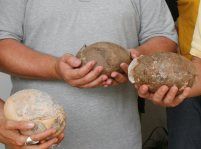
The team of the paleontologist expert in extinct birds Antonio Sánchez Marco, who has been working since 2010 in the Late Miocene sites in Órzola-Famara, has found a new specimen of ratite egg, large birds, possibly ancestors of ostriches, that lived in Lanzarote between 5.3 and 6 million years ago.
This is the seventh egg of similar characteristics that has been recovered to date and is the most significant piece of those found in the fourth excavation campaign that has just concluded. It is similar in size to a current ostrich egg, is in an excellent state of preservation and, like the previous ones, lacks an embryo.
This finding joins numerous fragments of ratite eggshells of different sizes, also of turtles, numerous shells of terrestrial gastropods and a vertebra of a small snake of the boa family, all remains collected since in 2010 Dr. Sánchez Marco began to develop the paleontological research project called Continental Neogene sites of Órzola-Famara, in which the Cabildo collaborates.
Unanswered questions
This is the fourth campaign of excavation work directed by Dr. Sánchez Marco, from the Catalan Institute of Paleontology Miquel Crusafont. For the moment, the new finding expands the radius of the area to be investigated, but does not shed much light on the big questions that have arisen around the presence of these animals in Lanzarote: how did they get here, how did they live, and why did they disappear.
Based on these doubts and depending on other remains that may be found, it could also be reconstructed how they really were, what they ate, what their environment was like and with what other living beings they shared the territory of what is now Lanzarote, which at that time could be emerged.
Previously, three interventions have been carried out. A first one of recognition of the sites and preparation, this one of small scale was in the year 2010. The other two, more important, were in 2011 and 2012. These actions have allowed to advance in the knowledge of this enclave and in the questions that it raises, at the same time that new sites have been located.
Due to its location and dating, -between 5.3 and 6 million years- a perhaps greater time span of the presence of ratites in this primeval Lanzarote can be contemplated. Likewise, some of the explanations that had been given in the past to justify the finding of these eggs have already been ruled out. For example, that of a temporary geographical union with the African continent.
Open the sites to the public
From the beginning of this excavation, Dr. Sánchez Marco and his team have shared with the Cabildo the idea of making these sites and their significance known to an interested and wider public. Thus, it is expected that the Valle Chico and Valle Grande 1 sites could soon be made visitable, without hindering or interfering with the research work on them.
Access to the first would require a small conditioning, but Valle Grande 1 would need more effort because it is a very extensive site, mostly covered by sediments from the surrounding slopes.


