
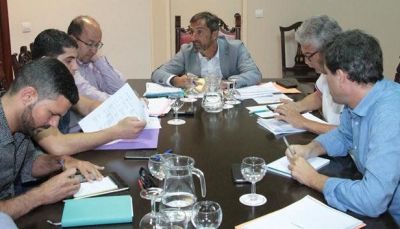
"That has nothing to do with the purpose of this commission." That is the phrase that the president of the Cabildo, Pedro San Ginés, has repeated the most during his appearance in the Investigation Commission on the awarding of water to Canal de Isabel II, in which he has not answered most of the questions that have been raised. In fact, he has had to be repeatedly warned by the one who has acted as president in this session, the spokesperson for Podemos Carlos Meca, who has had the vote of the entire opposition to relieve San Ginés during his appearance, in which the PP has not been present and to which the other three people who had been summoned to testify have not attended either: the mayor of San Bartolomé, María Dolores Corujo, the one from Tías, Pancho Hernández, and the former mayor of Yaiza, Gladys Acuña.
"The objective is for you to answer the questions asked by the members of the commission, and they are asking you perfectly justified questions," "you do not decide which questions are relevant," "if you do not want to answer, do not answer, but it will be recorded in the minutes that you have not responded", Meca has been repeating, who has had to remind Pedro San Ginés on several occasions that this time he was not the one presiding over the session.
However, San Ginés has continued with the same discourse and has insisted that it was not "relevant" to talk about the relationship of his friend and "legal advisor" Ignacio Calatayud with Canal Gestión; nor about the fact that the company of a former Canal executive who is also charged, Gaspar Cienfuegos Jovellanos, was hired to assess the offers; nor about the corruption investigations of several members of that Madrid company, including the one who was the manager in Lanzarote, Gerardo Díaz. Not even about the gaps in the only economic report that led to the awarding of the integral water cycle, which was prepared by the Consortium's manager, Domingo Pérez, and which did not even calculate what the offer of the other candidate, Gestagua, entailed economically. "About what Domingo Pérez's report suffers from, according to you, ask Domingo Pérez in the next session," he replied to Carlos Meca, referring to the appearance that the opposition has already requested.
"If I believed what you do, I would already be in court"
For nearly an hour and a half, San Ginés has also invited various members of the opposition to go to court with their "speculations" and "conjectures", and has repeated the message that he has been reiterating for years: that Canal's offer was more advantageous. However, to support this, he has focused again on what this company offered in investments, but has not wanted to talk about another key aspect: the variable fees, which involved millions of euros and were not even quantified.
In the case of canon C, Gestagua committed to deliver to the Consortium 75 percent of the money it received from desalination subsidies, bonuses or exemptions, while Canal reduced that percentage to 5 percent. However, neither of that canon nor of canon b, in which there were also notable differences between both offers, was an estimated calculation even made of what it could entail, despite being talking about millionaire figures.
"If I believed what you do, I would already be in court, that is the only thing I have to answer to this question," San Ginés ended up saying when facing Meca's questions on this point, in which the spokesperson for Somos Lanzarote, Tomás López, had also emphasized. "It is impossible for you to have the calculations of a future subsidy," the president has told the councilor of Podemos, who last year already denounced that only the difference of canon c could have meant more than 40 million euros of income for the Consortium. In fact, that is precisely the figure that Canal later promised more in investments, with works controlled and awarded by the company itself, which has several directors charged in corruption cases, among other things, precisely, for rigging in the awarding of contracts and works.
"He says that Canal's offer was better in everything, but it is not true"
"You say that Canal's offer was better in everything, but it is not true. Domingo Pérez recognizes that in canon c the offer of Gestagua is better. Isn't it strange, isn't it suspicious that it doesn't appear anywhere how much better it is? How is it possible that in a contract of 120 million euros the real economic difference is not quantified?", Meca has asked, who has questioned that what they did with this awarding was "an exercise of faith", because that report concluded that Canal's offer was better but neither quantified nor even scored the offers.
"In a contracting table of this Cabildo, that report would not have been admitted because it includes subjective conclusions and without quantifying economically," the councilor of the purple formation has underlined, also responding with irony to San Ginés's affirmation about the supposed impossibility of making a calculation of how much the canon c that the other company offered would have meant. "It seems that there is no economist on this planet who knows how much better Gestagua's offer is compared to Canal's", Meca has ironized.
"Advised in person by the legal services"
In addition, all the opposition groups have recalled the sentence of the Superior Court of Justice of the Canary Islands that San Ginés kept hidden for half a year and that ordered to review this awarding, considering it proven that "surprising alterations" were introduced in the specifications, when a negotiated procedure was used after the contest was declared void. "I am not here to issue value judgments on court rulings," Pedro San Ginés has replied to Manuel Cabrera.
As for who determined which aspects could be susceptible to negotiation -which is where the TSJC ruling focused-, the president has unloaded the responsibility on the deputy director of the legal advice of the Cabildo, Eugenia Torres, although he has also recognized that there was no written report indicating what changes could be accepted with respect to the specifications that were put out to tender. "We were advised, in person, by the legal services," he has replied to Tomás López, refusing to answer more questions on the subject when the spokesperson for Podemos has tried to ask for more details about the absence of written reports.
In addition, San Ginés has even said that he has "no clue" how a tender specification is made. "It is neither my task nor do I know it", he has added in response to questions from the councilor of Ciudadanos, Benjamín Perdomo, who was asking him to explain why Gestagua worsened its offer during the negotiations, going from offering to pay the initial canon in one go to making an offer to pay in six years, just one more than what Canal had offered.
At that moment, the president has tried to defend that "the payment of the initial canon did not affect the Consortium" but "the creditors", since with it the debt of Inalsa was settled, thus trying to suggest that it was not the most important thing in the negotiated procedure. However, as the councilor of Cs has reminded him, the specification gave half of the points precisely to the mode of payment of that initial canon, and that is when San Ginés has appealed to his supposed ignorance of the subject. And he has done the same when Carlos Meca has asked him how the company that made the other report, the technical assessment, was chosen, which in turn was the same one that made the specifications and that belongs to a former Canal executive charged with corruption. "If you have verified it, it must be so," the president has limited himself to answering. "Ask Domingo Pérez," he has added when facing new questions, pointing once again to the Consortium's manager.
He holds Domingo Pérez responsible for not having shown the minutes
In addition, San Ginés has also held Domingo Pérez responsible for the opposition not yet having been able to access the minutes of the meetings of the negotiating commission. The different groups had been asking for access to those minutes for months and this Monday San Ginés has begun by stating that he thought they had already seen them, despite the fact that in the last session he said that they could not be given copies and that he would ask for another report to see if they could go to the Consortium to consult them.
Now, he affirms that that report concluded that yes two weeks ago, but they had not let the opposition know, and he has blamed the manager for it. In fact, he has even made him enter the session to confirm it. "I did not understand that it was I who had to communicate it," "my mistake," Domingo Pérez has said, offering the members of the Commission to tell him a day to go and see them.
Among other things, the opposition wants to see those minutes to know why Gestagua went on to worsen its offer and what was said in those meetings with the companies, in which Ignacio Calatayud also participated, about whom the president has also avoided answering questions. "He advises this Presidency legally," he has limited himself to answering. As for the doubts that all the groups have raised about the fact that this lawyer participated in the awarding process when he later worked for Canal, San Ginés has reiterated again and again that that "has nothing to do with what is being investigated here".


