
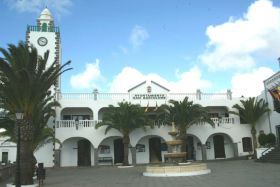
"Following the Footsteps of Ajei"
The term Ajei has remained in the legend and in the language of the municipality of San Bartolomé throughout its history. The echo of this word has motivated the research of historians, linguists, and anthropologists who have set out to follow its trail to rescue the reality of a village that may have been located on the land where the town with the name of a Saint stands today, before the Hispanic era. "From 1548 onwards, there is some documentation that speaks of Ajei, but the writings in which I have seen the toponym refer to different parts of the town, rather to the outskirts," says José Hernández about the studies he has conducted with Marcial Alexis Falero and Antonio Montelongo and which he has collected in an edition titled "Following the Footsteps of Ajei."
The different variants of "Gey," "Hey," "Ajey," or "Breñas de Ajei" were names of a village, of which many unknowns remain to be clarified today, that stood on the old hermitage. "I found documentation that referred to money that was paid to maintain the hermitage of Saint Bartholomew located in the place of Ajei," although he acknowledges that "it is not reliable documentation to get to the bottom of the matter." The thread of history is still confusing, and the limits on which this village was located are not rigorously specified. That Ajei existed seems unquestionable; where, when, and how are still some of the questions to be revealed.
Why Ajei, and with a Latin i?
The term Ajei in San Bartolomé would complete the historical memory of the municipality. Both the history of the Canary Islands, as well as the Island of Lanzarote, and therefore, the municipality of San Bartolomé, are divided into a pre-Hispanic and a Hispanic era. Ajei would recover the pre-Hispanic presence in the life of the municipality, the stage before the arrival of Juan Bethencourt in Lanzarote in the 15th century. Recognizing the term Ajei also means rescuing that there was a trajectory of San Bartolomé before the conquest. "With Ajei, we institutionalize a part of our history," says De la Hoz. With San Bartolomé, only the Hispanic part would be represented; Ajei would be like a symbol of reminiscence.
And why is the proposed toponym Ajei and not Ajey, even though it is more common to find this second formula? The experts' answer is that as a proper name, it is equally valid to write "Ajei" as "Ajey," although linguists advise using the -y in words that end in the diphthong -ei, since this is the tradition of the Berber language, which has had a great influence on the Canarian dialect, and of Spanish. However, the spelling with -i has been officially adopted because it appears this way on the heraldic shield, and it would be "complicated" to change it, according to the government group of the City Council. In addition, in the institutions that collect this term, such as Casa Ajei or Grupo Folklórico Ajei, it appears written with the Latin spelling.
Unnecessary initiative?
Juan Antonio de la Hoz justifies the decision of the Government Group to promote the modification of the name as a way to "institutionally channel" a proposal that people specialized in the history of the municipality, such as Agustín Payarés, Silviano Corujo, Antonio Montelongo, had raised since the eighties.
For the opposition, it is an unnecessary initiative that, while not harmful, lacks importance among the demands of a population.
But with voices in favor and voices against, the concrete thing is that San Bartolomé, next September, will become the first Canarian municipality to carry out a popular consultation. For this, the City Council has approved a specific regulation that regulates the referendum procedure. "With this, the decision does not remain only in an elitist sector. It has also allowed us to carry out an information campaign so that everyone has the possibility to give their opinion," says the councilor of San Bartolomé about an initiative that the Socialist Party proposed, since initially the Government group proposed the approval by absolute majority in the Plenary of the Corporation. The option of popular consultation allowed the unanimous support of all political forces, although the change of name was not a proposal well received by the opposition parties.
De la Hoz trusts in popular support. "In the summer of 2005, a survey was carried out, and 60 percent agreed, while only 15 percent rejected the proposal because they do not consider it such an important issue." Although the referendum is not binding, the Corporation will vote in accordance with the final result. Another debate will be the representativeness of the consultation, since many believe that abstention will delegitimize the result. Although de la Hoz believes that if it goes ahead, "people will continue to talk only about San Bartolomé. When they say "de Ajei," they will do so to name it with pride."
Three reasons to add Ajei
For history: For José Antonio de la Hoz, rescuing Ajei is ensuring that future generations have knowledge of an aboriginal history that is part of the idiosyncrasy of this Lanzarote town.
For inquiry: "This term represents a stage that we do not know," acknowledges the Councilor for Culture of San Bartolomé. Therefore, the idea is not only to save the term but to continue with an investigative work that allows building the pre-Hispanic past of San Bartolomé.
For identity: Ajei would be the surname of the town, which would provide a distinction, a "lordship." This would avoid confusion with other homonymous municipalities. "The act of the councilor who entered through Alternativa Ciudadana, first went to San Bartolomé de Tirajana, in Gran Canaria. Each of the inhabitants could tell a similar anecdote." For the councilor, the addition would help solve more than one administrative problem.


