
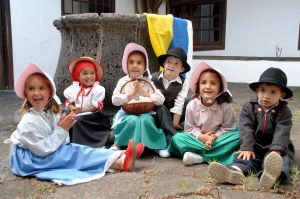
Lanzarote has been part of the project 'The Canarian School Moves' in which primary school students have carried out exchanges to interrelate in a fragmented territory such as the Canary Archipelago and share the landscapes and peculiarities that each island offers. But time has also been dedicated to the student population with the 'Live Canarias at School' days, a broader program where teachers, parents, and students from schools throughout the Community have been involved "with the common denominator of Canarian identity," as Juan Cruz, the island director of Education, says. This last cycle aimed to emphasize Canarian content and promote the culture with its own characteristics of the islands. It was an exchange of schools that have a lot of experience in teaching Canarian content and including it in their annual programs, "but it is a project that has been running for a long time, it is not something specific like the celebrations that take place on Canary Islands Day," says Juan Cruz.
But these programs are carried out at the regional level. According to the Island Directorate of Education in Lanzarote, there are more than 100 improvement projects in educational projects where the central focus is the content that refers to the history, customs, and culture of the islands, "especially to work in a more professional way on the geographical and historical context of the archipelago," Cruz emphasizes, adding that the way of teaching this content has changed a lot in the last 30 years since "before things were done in a somewhat folkloric way, and that has been left behind to move to a more rigorous and coherent aspect." Since 1999, according to the island director, schools have become places where there is a continuous practice of defending Canarian values. "It is about reinforcing the historical reference that was in the dark since the 70s, we have changed in the ways of life and we have to be aware of how people lived before, and it is necessary to talk about tradition and modernity," Cruz emphasizes.
Overpopulation and a universal culture
6% of the students enrolled in Canarian schools are foreigners. In Lanzarote, that figure shoots up to 17%. That is, two out of ten students are foreigners. While the national average is around 5%. "This is a factor of cultural wealth to which the archipelago has always been open, but we have the responsibility to ensure that classrooms become the cultural reference so that this new population assimilates our reality," says Juan Cruz.
There are schools, such as the Concepción Rodríguez Artiles school in Puerto del Carmen, where 55% of the students are of other colors, languages, and cultures. The director of the center, Daniel Sánchez, assures that there are 32 different nationalities "and this is a considerable wealth because the children have established the ethical values of coexistence and respect." In this center, according to its director, they do not forget that they are in the Canary Islands and "it is necessary to instill the reality of the Island with acts such as the Canarian Week that we have celebrated."
The future of the islands is in the schools, at least that is the slogan that has been made clear by those responsible for education. "They are the tomorrow and now, more than ever it is necessary to preserve and protect the issue of the traditional ways of life that have always been here," says Juan Cruz. Regarding the population growth due to the massive arrival of foreigners, the island director assures that "the problem in schools is not multiculturalism, but the amount of modisms and commercial symbols that invade us continuously." For Juan Cruz "commercial influences are more dangerous than the fact that we have a multicolored population."
Textbooks are increasingly including content specific to the autonomous communities in their syllabuses. "In all textbooks right now there is a part referring to Canarian content, especially in the subject of knowledge of the environment." As the head of education in Lanzarote says, "these subjects are provided for by regulations." In any case, there is academic freedom that allows schools to act to the detriment of subjects with the Canary Islands as a topic of study or give it a different treatment. Juan Cruz believes that a lot has been achieved, "for example in secondary school, where there are specific optional subjects on the history of the Canary Islands, but it is still insufficient."
Cultural knowledge is a topic that is treated in a dynamic and direct way in schools. This is how they try to teach the practice of native sports such as Canarian wooden ball, the conejero stick, Canarian wrestling and other ancestral sports practices. Traditional dances, songs and clothing are also part of the educational reinforcement program. "These are specific activities, but very important, not only for the Canarians, because for the people who are now coming from outside they serve as a point of inflection and debate," adds Cruz.
But not everything is tradition, the island director, stressed that throughout the course programs are carried out to encourage the reading of works written by Canarians. Occasionally there is an intense topic on Canarian literature that has been done from the General Directorate of the Book to promote Canarian authors of local, island and regional scope, for which a presentation campaign has been made by the centers with the authors themselves," he points out.
From the Island Directorate they are satisfied with the advances in education with content specific to the Islands, "but the real work is in the schools, which sometimes go unnoticed." According to Juan Cruz, a large majority of centers in Lanzarote work on these contents within their annual program during school hours and with support activities, in addition to the fact that "in most schools they are strongly committed to giving relevance to this issue throughout the year and do not do it on a specific day such as the celebration of Canary Islands Day," he concludes.


