
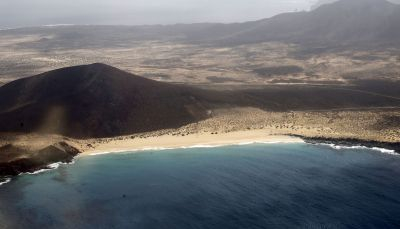
The Xunta de Galicia and the University of Santiago de Compostela (USC) will collaborate for the next five years on the transnational LIFE insular project for the integrated restoration of the habitats of the Cíes, Ons and Sálvora islands - which together with Cortegada form the National Park of the Atlantic Islands - and recover their natural landscape from 70 years ago, together with La Graciosa and Ireland.
After signing the collaboration agreement with the USC, the Minister of the Environment, Ángeles Vázquez, stressed the importance of this transnational project for Galicia, which also leads the initiativa by hosting three of the five islands on which the restoration and sustainable management of island habitats will focus.
The coordination will be carried out by the USC while the Autonomous Government will be responsible for the technical execution of the initiative, as stated in the agreement signed this Monday at the Institute of Agricultural Biodiversity and Rural Development (Ibader), in Lugo, between the Minister and the rector of Compostela, Antonio López.
The objective of the project is to "promote a favorable state of conservation of the habitats of the island spaces belonging to the Natura 2000 Network in the Atlantic Ocean, while increasing their resilience as a measure of adaptation to climate change."
To this end, attention will be focused on eight Special Conservation Zones (SACs) located on five islands, which are - in addition to the three Galician islands - La Graciosa, and Ireland.
Through this transnational collaboration initiative, the impact of possible external disturbances on the areas of action - risk of gales or catastrophic wind erosion - will be minimized and, as explained by the Minister, a recovery of the natural landscape of these islands will also be sought with the challenge of "reversing" the situation to what it was 70 years ago.
To achieve these objectives, the project plans to execute on the ground a series of actions focused on habitat types 2.130 and 4.030, corresponding to coastal dunes with herbaceous vegetation and European dry heaths.
This role will correspond in Galicia to the Ministry, which will execute actions to eliminate and control invasive alien species, suppress forest plantations and protection measures against human activities that affect these habitats, such as controlling the transit of visitors or installing passive sand collectors.
The project also includes a public awareness and dissemination strategy through conferences on special dates, such as Natura 2000 Day or European National Parks Day, as well as volunteer actions, school workshops and placement of information panels, among others.
Finally, a conservation plan is also foreseen once the LIFE insular project is completed - with a planned date of December 31, 2026 - which would allow for its monitoring and continuity.
The Atlantic Islands National Park is the only Galician natural space that concentrates six of the main environmental protection figures at the international level, so the LIFE insular project will allow to protect the natural wealth that earned it these recognitions and prepare it to face the challenges of climate change.
With a budget of more than 5.2 million euros to be executed until 2026, the Xunta will have an estimated budget of almost 750,000 euros, of which 300,000 euros will be allocated to investment expenses; while the USC will have an assigned funding of 1.08 million as coordinating beneficiary.
The economic contribution of the project by the European Union will amount to 3.95 million euros channeled through the LIFE program, dedicated exclusively to the environment and climate action.
Among the other partners that will benefit from this transnational project are also the Autonomous National Parks Agency and, on the Irish side, the Department of Housing, Local Government and Heritage and Coillte CGA


