
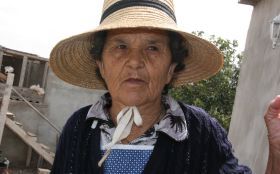
In the spring, during the harvest or collection of salt. With the dry winter wind, in the cleaning of salt flats, cuts and cookers. At the age of twenty, Aurora got married and for a while left her job in the salt mines of Sardinia to take care of her children. Later, she returned to the salt in Janubio.
She worked there for two decades, this time with her friend and neighbor María. María Rodríguez exchanged the fruit harvest for salt. "It wasn't a very hard job, although when it was hot, we got very tired," she explains, looking towards the salt mines. "There were a lot of people working there, who came from Tinajo, Las Casitas, Femés, Yaiza, Uga, Las Breñas, Playa Blanca?". María and Aurora continue to cook with Janubio salt. "Sometimes I think I would like to go back to work there," explains Aurora nostalgically. "If it weren't for my health, I would go back."
In Lanzarote there were up to 26 salt mines. A large part of the island's coastline was occupied by these exploitations, even that of Arrecife. The canneries requested huge quantities of salt to preserve all kinds of fish. In the seventies, with the appearance of refrigeration chambers, the salt mines were abandoned one by one, leaving only the well-known Janubio salt mines, those of Guatiza and those of El Río today.
"When the ice started, my father said "goodbye salt mines!, the salt is not going to be sold anymore'", explains Aurora Cedrés. "In the sixties the owners of the salt mines of Sardinia died, and everything fell apart, because the salt was not needed". It was a hard blow for dozens of families who, throughout the Island, lived off the salt mines. Some workers who had to look for another day's wage.
The current demand for sea salt has decreased considerably. Refrigeration chambers now preserve the fish, and ships and airplanes allow the salt from the mine to be brought to the Canary Islands, which is much cheaper due to the mechanization of the extraction methods. In Janubio, at this time, production represents only twenty percent of the exploitation's capacity.
"We have surpluses, and we do not produce more because of the difficulties in getting this salt out," explains Carlos Padrón Lleó, current owner of Janubio. Of the ten million kilos that were produced annually in the most buoyant times, two million kilos are now produced each year. Product diversification is important.
Although sea salt has great gastronomic quality, it is also used for bath salts or swimming pool maintenance, a use that is increasingly in demand. "Some hotels and complexes on the Island buy our salt to keep their pools clean without the use of chemical products, such as chlorine," says Padrón. "Through sea salt, they manage to have clean water, and protect the skin and eyes of users".
Production is not the only thing that has decreased in these thirty years. Of the more than 200 workers that Janubio had in the middle of the century, today there are only nine left. The salt mines have ceased to be a means of life to become a tourist attraction. But behind an activity in detriment hides an important series of landscape, cultural, ethnographic, patrimonial and even architectural values.
"These spaces are a symbol of identity," concludes Padrón. Some localities near Janubio have their reason for being in the old salt activity. "My parents already lived here," explains María, pointing with her finger at the houses that make up La Hoya. Janubio began to be built in 1895. It was Carlos Padrón's grandfather, together with other partners, who decided to locate some salt mines in the place that remains more than a century later. Its construction was costly. It was not completed until fifty years later. But the demand for salt was such that they even had to buy the production of other smaller salt mines on the Island to supply their customers.
Janubio occupies an area of 45 hectares. "It is a legacy that is given to us, and a tribute to the women and men of Lanzarote," says Padrón. "Therefore we have to conserve them and transmit them to our children, because they are unique places."
The future of the salt mines
The Padrón Lleó family hopes to change the lines of the market, start exporting its salt to other islands of the archipelago, as was done in the past. However, strong competition and the lack of knowledge of the properties of sea salt make this task difficult. For this reason, the Janubio salt mines demand a greater commitment from the institutions.
"There has never been a concern for this sector, to help it in the face of the circumstances that have caused the decline of salt," says Carlos Padrón. "Our surprise is that there is a lot of talk about other products, such as wine or milk, which I defend, but I would like salt to be on equal terms". Padrón alludes to the promotion campaigns for Lanzarote wines and the subsidies granted to the winegrowers of La Geria. "If we manage to produce more salt and get it to the market, we are not only protecting a product but also a landscape, a sign of identity."
Now, the Padrón Lleó family trusts in a good predisposition on the part of the new Corporation of the Cabildo. Meanwhile, the Vice President of the First Institution of the Island, Fabián Martín, admits the lack of aid to the salt sector. "Sincerely, I have to recognize that it is something that has not been talked about, but in case it was done, it would have to be demonstrated that the salt exploitation meets all the conditions and that it is reasonably profitable, what we cannot do is give aid to this type of activities that have sometimes become obsolete and abandoned."
In 1995, the Janubio salt mines received a small aid from the European Union to repair part of the facilities. Since then, the exploitation has continued to function exclusively by private initiative. "On the part of the Yaiza City Council there has always been good will," says Padrón. "But it has not translated into effective aid measures."
Meanwhile, María and Aurora tell their grandchildren the history of the salt mines. From time to time they walk there, and mingle among the tourists who photograph the spectacular sunset without knowing that next to them they have two of the protagonists of a marvel made by the hand of man.
Salt Museum
"People from outside do not know how salt is produced, they see the salt mines but they have no idea what they mean". It is a phrase from a tourist from Gran Canaria, while observing the magical panorama of contrasts of whites and pinks, with the salt mines at her feet. In order to put an end to this ignorance, the Padrón Lleó family is studying the possibility of building an interpretation center or Salt Museum in the Janubio salt mines.
It would be a complex formed by the museum, a bar and restaurant, a parking lot and a store. The Janubio salt mines were declared a Site of Scientific Interest in 1987. Twenty years later, in February of this year, the COTMAC published in the Official Gazette of the Canary Islands the Conservation Standards for these salt mines. "It is about ordering the visits that we already have and providing the salt mines with a tourist infrastructure that they do not have now." For the moment, there are no deadlines, although the technicians are already working on the project.
"We intend to do something that is integrated with the environment. Now, with the rules in hand, we know what we can do and what we cannot, but we have had to wait twenty years for it," explains the current owner of the Janubio salt mines, Carlos Padrón Lleó. The way in which this future Salt Museum will be carried out is not yet clear. The Padrón Lleó family intends to involve the institutions.
"We have to agree and support each other, the objective is common and beneficial for all," says Padrón, who explains that "a public and private agreement could be carried out with the Yaiza City Council. Something like what exists in La Geria". However, on the part of the Cabildo, this involvement is not so clear. "We were waiting until September to make a decision," explains Fabián Martín, vice president of the Corporation.
"In any case, if that proposal is privately owned, they should be the ones to determine how they plan to do it. The Cabildo would be willing to take the initiative, as long as a project that started from the Institution and an agreement was reached regarding the management of the land, between the two parties".


