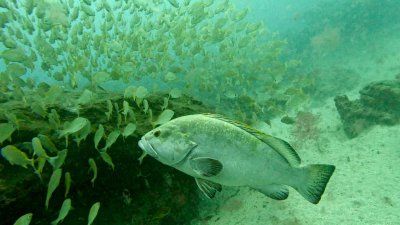
The Amplía Project, a scientific initiative that analyzes the marine spaces of Lanzarote and the rest of the eastern islands to understand the state of their biological resources, has been delving into the ocean depths for two years. As part of this research, the Biodiversity and Conservation Group of the ECOAQUA University Institute will present next week the results obtained after two years of work.
Its purpose is to convey to the population a true image of the seabed and achieve, through consensus, an initiative to extend the protection that the island already holds as a Biosphere Reserve towards the sea.
The principal investigator of the Amplía Project, José Juan Castro, Doctor of Marine Sciences, explains in a conversation with La Voz that this initiative, which arose at the University of Las Palmas de Gran Canaria, began in November 2023, when a group of researchers and technicians began to collect information on the marine biodiversity of Lanzarote, Gran Canaria, and Fuerteventura.
"We have seen that the fishing resources of the two islands [Lanzarote and Fuerteventura], we add the two because they share a beautiful platform, are overexploited, and of the 20 most important species, only three are in a sustainable state," he explains. Specifically, the bocinegro, the sama, and the vieja are the only ones that remain in a sustainable quantity for their survival.
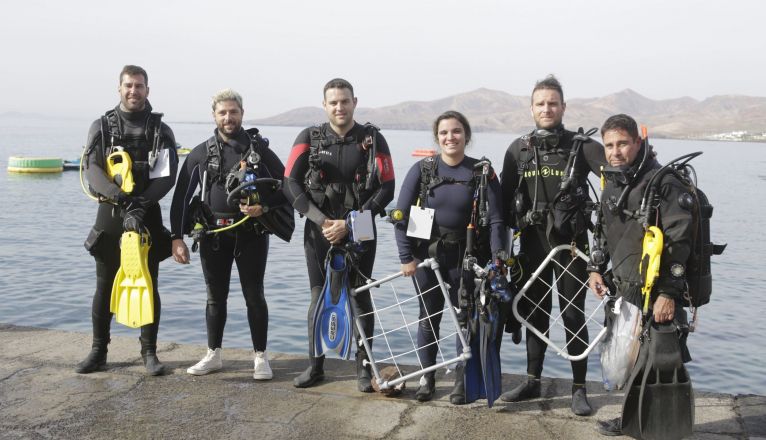
In April 2024, the second part of the project, the intertidal and subtidal campaign, was launched through diving initiatives in the four cardinal points of each island. "There, we pointed and photographed algae and little animals that we found," Castro narrates. In this process, they also surveyed professional and recreational fishermen, divers, and residents, and made inventories of the maritime infrastructure, from ports, boats, cranes, and pontoons.
In the case of Lanzarote, they explored the seabed of Punta Mujeres and Arrieta, the channel between Lanzarote and La Graciosa, the seagrass areas of Guacimeta, in San Bartolomé and Tías, Playa Blanca together with the Janubio area, both in Yaiza, and La Santa, in Tinajo.
For example, analyzing the richness of fauna in the intertidal zones, they found that Punta Mujeres was the island locality with the most different species. In total, they detected 33 species from various taxonomic groups. The largest quantity was 15 types of mollusks, followed by eight species of crustaceans, four of fish, four of echinoderms, and two of cnidarians, which is the group that includes jellyfish and anemones.
It should be noted that in the intertidal space of the beach of Janubio, in Yaiza, they also found 30 different species. The most relevant is the presence of eleven species of mollusks, six of echinoderms, and another six of crustaceans, as well as four of fish, two of annelids, and one of cnidarians.
A project with citizen consensus
"The Biosphere Reserve, in principle, is not a protection that prohibits anything; its philosophy is that society adopts a strategy for the conservation of biodiversity in certain areas," Castro defends. "One is a management of framing laws, but that people accept by their own conviction that there are sites that must have special protection," he continues.
The Workshop for the Transfer of Results of the Amplía Project will take place on October 2 at the El Fondeadero Civic Center in Puerto del Carmen between 5:00 p.m. and 7:00 p.m. In addition, they will also take the results to the island of La Graciosa, with another workshop on October 7, between 4:30 p.m. and 6:30 p.m. at the La Graciosa Inocencia Páez Sociocultural Center in Caleta de Sebo.
In these workshops, the researchers will present all the raw maps of biodiversity, species, and critical areas detected in Lanzarote, working groups will be formed, and strategies to be carried out in each place will be proposed.
"The idea is that with the help of the people and with the data, different groups can participate and establish a strategy of how the Biosphere Reserve of Lanzarote should be organized and how it should be," he continues.
Initially, Castro defends that the contributions arise from the population based on the data collected by the Amplía Project. "The idea is that it is a collective decision, a mixture between citizen science and traditional science," explains the researcher.
The project collects data such as the number of species found or the sizes, but also exposes realities such as the presence of wastewater discharges in spaces where endangered species live, such as the angel shark (squatina squatina), and seeks that, through the data collected, decisions can be made for its protection.
At the same time, he narrates that one of the problems these experts have encountered is the lack of temporal records that help to show if marine life was the same in these areas ten years ago.
For the moment, when comparing areas of the same island, they have determined that there are spaces such as Arrecife or the coast of Tías where there is greater degradation of marine biodiversity. "The area of the Port of Arrecife is more affected because it has a lot of waste, in the Puerto del Carmen area there are also sites with discharges," continues Castro, who indicates that the data still needs to be fully analyzed.
A Canary initiative with European funds
With a budget of 400,000 euros, financed by the European Union (NextGenerationEU), the Ministry of Ecological Transition and Demographic Challenge, and the Ministry of Ecological Transition and Energy of the Government of the Canary Islands, AMPLIA is part of the call for subsidies for the financing of actions in Biosphere Reserves within the framework of the Recovery, Transformation and Resilience Plan that will culminate in 2026.
In addition to ECOAQUA, the Department of Mathematics of the ULPGC, as well as the Biosphere Reserves of the islands of Gran Canaria, Fuerteventura and Lanzarote, and the Marine Reserves of the Canary Islands, also collaborate in this research.
Attendance must be confirmed at [email protected].
Add La Voz de Lanzarote as a preferred Google source.
Stay informed with the latest current news.