A new scientific project seeks to analyze the maritime spaces of Lanzarote and the rest of the eastern islands to find out the state of their marine resources and determine whether the protection of the Biosphere Reserve should be extended to the sea.
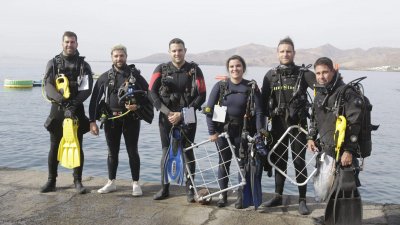
Specifically, this is the Amplía Project, led by the Biodiversity and Conservation Group (BIOCON) of the University Institute of Research in Sustainable Aquaculture and Marine Ecosystems (ECOAQUA), which is already carrying out the first analyses on the seabed of Playa Chica in Puerto del Carmen.
"In Lanzarote there are areas that are not yet protected and included in the Biosphere Reserve," begins the director of the Department of Biology of the University of Las Palmas de Gran Canaria, José Juan Castro, in charge of the direction of the Amplía Project. Currently, the Biosphere Reserve extends to the waters of the Chinijo Archipelago and La Graciosa and part of the northwest of the island, but a large part of the island's coastline is not yet covered.
For this reason, the aforementioned research seeks, through an analysis of marine spaces, to determine which new locations could be protected or, in some cases, restructured. To this end, they will offer a scientific and analytical basis for institutional decisions.
"Generate a discussion based on the existing scientific disposition and not on personal opinions," defends the director of the 'Amplía Project'
"These criteria help to see why the nucleus [strict protection zone] is placed in one place and not in another, why [the Biosphere Reserve] is extended to the entire island coast or not," explains Castro. Currently, protected areas are divided into three zoning areas: buffer zone, nucleus and transition areas.
The core zones are those that advocate the preservation of ecosystems and biological diversity and where protection is more strict. Meanwhile, the buffer zones are those that are in the vicinity of the nucleus and where activities that do not threaten the conservation of the space are foreseen, and in the transition zones socio-economic development is allowed, that is, productive activities, such as fishing or recreational water sports.
Likewise, in this case not only will spaces with ecological value be taken into account, but geological or cultural factors will also come into play. "For example, a place that has a legend," he adds.
First phase of the project
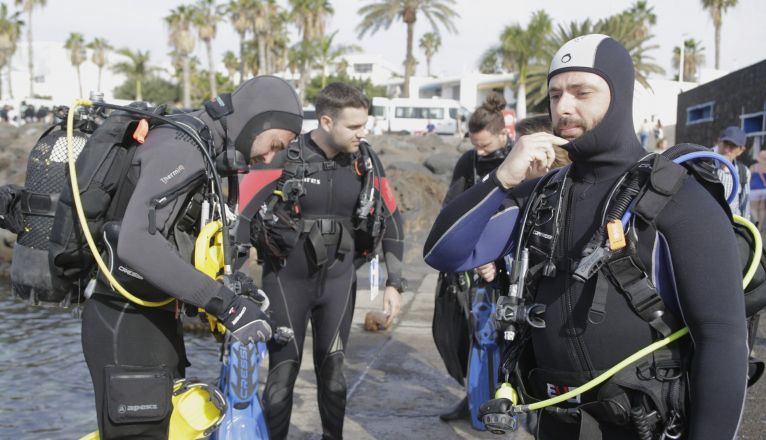
The human and economic capacity of the research work, valued at 200,000 euros, reduces the work area to the eastern islands. The Amplía Project is in its initial phase and not all the hiring has been carried out yet. Currently there are nine professionals, including technicians, doctors and external personnel, working on this initiative. Some of them will carry out campaigns at sea, while others will carry out a theoretical and mathematical analysis in the laboratory.
At this point, six experts are already collecting information from the seabed of the island with diving campaigns. In these immersions they are preparing a visual census. After that, they will analyze the data and study the indicators that reflect the situation of the resources, ecosystems and species in each area.
At the same time, the experts will interview citizens and analyze the censuses of public data in relation to the coastlines, to build their own model.
Once the resources have been analyzed, "interest groups" will be created for the management of these Reserves. "These interest groups will be made up of fishermen, divers, recreational fishermen, non-governmental organizations and administrations," says José Juan Castro. The scientific data will serve to inform the economic and social groups of the state of the seabed of each island and, as a result, make joint decisions on how to protect them.
"The current protections are not structured on the basis of scientific information and that is what we need to avoid, to generate all that basic information so that the decisions taken are in accordance with the real state of the resources and ecosystems."
A Biosphere Reserve is not a Marine Reserve
The initiative of the Amplía Project aims to extend the Biosphere Reserve to the sea, but it should not be confused with a marine reserve. In the eastern province there is only one marine reserve and it is the one in the north of Lanzarote, on the island of La Graciosa. "The marine reserve allows fishing a certain number of days, a certain number of kilos and there are many more restrictions and it is more limited. Fishermen can only fish with a hook and not use a trap or nets," he explains, there are even areas where fishing is prohibited, such as in Roque del Este.
In contrast, the Biosphere Reserve has a "slightly more cooperative protection among citizens. It is not so rigid and strict, but where there is greater citizen participation." In this sense, it is not about prohibiting but about reaching consensus with the population to preserve these spaces, although coercive measures may be established if necessary.

Add La Voz de Lanzarote as a preferred Google source.
Stay informed with the latest current news.