
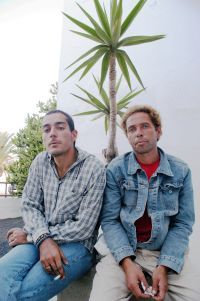
Stationed under a tree, 'El Gallego' observes the constant hustle and bustle that permeates the Drug Addiction Care Center. On the busiest days, around 200 people may pass through there in search of a dose of Methadone, not counting those who come for consultations with specialists or to receive other types of treatment. However, this young man, who owes his nickname to his place of origin, has only come to accompany his friend.
After trying for more than an hour to get someone to briefly tell us their dramatic story, 'El Gallego' looks at us and says, "I'll answer you, what's it for a newspaper?" Thus, in such a natural way, he begins to recount his life. "With drugs, you lose everything, from your family, your friends, your job, and even your dignity, everything. It eats you up inside and nullifies you as a person." With this forceful statement, 'El Gallego' immerses us in the human side of drug addiction statistics, to which we are all already accustomed.
"Only 15% of the people who come to the center achieve a full recovery," says Rosa Torres, coordinator of the Drug Addiction Area of the Department of Social Services of the Cabildo. Although this data is very relative because the objectives set when a new person arrives at the center is that they stop using psychotropic drugs. "Then the percentage increases because, after completing the entire treatment, our patients are free of narcotics, which does not mean that relapses do not occur later."
"Drugs change your personality, turning you from a saint to a demon. No matter how good you are, you end up becoming disgusting," 'El Gallego' continues, who at 32 years old, has been immersed in this world for more than 15 years. Like him, there are many people in the same situation. The lives of these patients are not easy, as behind the abuse of drug use lie serious cases of social integration. Two young people we found at the Drug Addiction Care Center (CAD) told us that they have been to prison a couple of times, "because sometimes you even steal to get the money to buy because you only think about consuming," one of them explained.
Everyone we found at the CAD confirmed that the process of abandoning the world of drug addiction is very hard. Normally, these are programs that last from two to three years in which many relapses occur. "I have been on Methadone for six years, and without it, I would start using again," explained a drug addict who did not want to reveal his identity.
'El Canario', who came to the center accompanied by his friend, however, tells us that although he has been in treatment for only a few weeks, he does not want to do it again with Methadone because, according to him, "the 'withdrawal' from Methadone is very hard, I had a very bad time when I had to stop taking it because I was imprisoned." Now, 'El Canario', who has tried detoxification again 20 days ago, is fighting to "get out of this shit," as he says, thanks to some pills. "The pills work well for me, they relax me and take away the withdrawal symptoms."
I need help!
Almost all the people we met at the Drug Addiction Care Center told us that they started using drugs at a very young age. Eduardo, for example, at twelve years old was already smoking his first joints and drinking his first mixed drinks. Two other drug addicts, who prefer to remain anonymous, explained that they tried heroin at 16 or 17 years old. "When we were little, we didn't know what drugs did, and when we realized it, it was too late. There are many people like us," one of them explained.
Despite these statements, drug addicts take time to realize that they need help. "I knew I had a problem a long time ago, but it was really two years ago when I asked for help," said Paula. 'El Gallego', on the other hand, realized the problem when he was already 'hooked', "when it goes from being a fun to becoming a necessity, when you see that you miss it one day and you start to feel bad. Then you realize that it's no longer a game."
Rosa Torres, the coordinator of the Drug Addiction Area of Social Services of the Cabildo, explained to us that all types of people who present an abuse of substance use can come to the CAD. "In recent years, there has been an increase in the number of people who come for cocaine and alcohol use." Specifically, in 2005, the Drug Addiction Care Center registered 29% of cases for cocaine use, 27% for problems with alcohol, and behind, with 10% of cases, heroin. "Lately, it is also being observed that the initiation to drugs occurs at younger ages and, in parallel, that we treat cases of increasingly older people, 50 years old, and even some 60 years old."
Many of these people come to the center on their own because they see themselves in an extreme situation, although others, according to Torres, are accompanied by family members, friends, or guardians, who sometimes force them to start treatment. Although it starts, good results are not always obtained, since one of the main requirements for success is that the drug addict is aware that he wants to stop using. "I have tried it several times, but if you are not convinced, it is useless," 'El Gallego' told us. The coordinator of the Drug Addiction Area explains that relapses are greatly influenced by the subject's own personality and the circle in which he operates, "since if he relates in an environment where there are no users, it is more difficult for a relapse to occur. Despite this, there are also people who are not able to overcome the difficulties without resorting to consumption."
Drug Addiction Care Center
The Social Services area of the Cabildo of Lanzarote has installed a service for drug addicts. The coordinator of this area, Rosa Torres, explained to us that they attend to drug addicts through three centers: the Drug Addiction Care Center (CAD), where several programs are carried out, the Day Center and the Therapeutic Community.
The CAD is an outpatient center where the Methadone Maintenance programs, the Drug-Free program, a specific one for Minors, and the Reintegration into Society program are located. Within this center, the detoxification of drug addicts is carried out, "this means cleaning the body of narcotics," specified Rosa Torres. For this, "in addition to the treatment we prescribe, we make them come here to attend consultations with psychologists, social workers, and we also perform periodic tests to check that they are not really consuming." The next step is to achieve a dehabitualization, that is, that they abandon the consumption habits they have acquired. For this, the coordinator of the Social Services Area explains that they house drug addicts in the Therapeutic Community. "There they welcome boys who cannot be on the street because they cannot control their desire to consume." In this community, they spend approximately seven months, which is the period where dehabitualization has been carried out. "Once this phase is finished, instead of sending them directly to the street, what we do is admit them to the Day Center, where they are from eight in the morning to eight in the afternoon," Torres told us, who also explained that in this center, workshops are held aimed at social reintegration and job search.
Methadone is also supplied at the Drug Addiction Care Center to all people who need it. Rosa Torres tells us that they come daily for their dose, "but when a person is stable with Methadone, we do not force them to come daily, but first we tell them one day yes and one day no, then twice a week and finally once a week."
Ideally, according to the coordinator, when they are normalized, gradually reduce the dose of this drug until reaching zero consumption. But it seems that it is very difficult to achieve, since in the center there are people who have been on Methadone for more than ten years. "This is a disgrace because they are not interested in us getting well because they continue to receive money," says a drug addict who was in line to collect his weekly dose.
The problem of drug addiction is complex, but even so, it is worth asking whether the programs that are offered are well oriented to help this group, which although, at times, may have the will, must be taught to know how to channel it. For now, 'El Gallego', who now does not want to undergo treatment, tells us that he is on the street, "like a bum, on top of that a "junkie", without a damn penny and with his arms busted."
"EL GALLEGO", FIFTEEN YEARS HOOKED ON HORSE
"The first time I tried heroin was because I saw a friend smoking it. I told him to give me a couple of puffs to see what it tasted like. It made me feel very bad, I vomited and fell half asleep, but I liked the high a lot, I felt very relaxed, I forgot about the problems and everything, it's the only thing it helps with." 'El Gallego' is 32 years old, and despite his youth, he has lost the best years of his life. He has been 'hooked on horse' for more than fifteen years. Although he has lived in many places, he is now in Lanzarote, according to him, "due to the vagaries of life." He lives on the street, he is alone, he has no job and he only has a couple of friends as support. "I make a living as I can, today I have been collecting scrap metal, other days I beg, and sometimes I live off what my friends give me when they see me very bad."
'El Gallego' is not currently following any detoxification treatment, although he says that he has tried it on some occasion. "I have been in Proyecto Hombre and on a Farm, but when I left and started working, I screwed it up." And the process is hard and relapses are very common. "You have to have a lot of willpower and desire to live in order not to relapse. Now I don't want to be admitted because if you are not really convinced of leaving this world, the treatments are useless. You have to self-convince yourself that you want to get out of drugs." Although he still does not want to start another treatment, the friendship towards his friend 'El Canario' means that, at the time of making the report, we found him accompanying his colleague to the Drug Addiction Care Center to collect his medication.
RENEWED HOPES OF "EL CANARIO"
'El Canario' does not owe his name to the bright blonde color of his hair, but to his island origin. He lives in Lanzarote, despite being from Las Palmas. His story is similar to that of many people who are in the same situation. I tried heroin for the first time at 25 years old because I had family members at home who were consuming it, I thought that a few puffs would not hook me, but I fell. Now he is 42 years old, he is starting a detoxification treatment and has found work in construction.
Although the life of 'El Canario', like that of many other drug addicts, has not been easy, since he has been in prison on a couple of occasions. The afternoon we approached him, he had been without consuming for 20 days and had gone to the Drug Addiction Care Center in search of his medication, but they did not supply it to him because he could not attend the scheduled consultation. "This morning I couldn't come because I had a job interview and now it turns out that if my doctor is not there, they can't give me the pills. So what do I do now because if I don't take the medication I run the risk of relapsing and I can't come tomorrow because it's my first day of work." Despite these small inconveniences that, for him, pose a big problem, 'El Canario' has hope that this time he will "get out of this shit".
PAULA AND EDUARDO LOOK TO THE PRESENT
Paula and Eduardo have a single future project when finishing the detoxification treatment, "to live day by day and not consume again." They met in Valencia, in the Vida Project, and love arose between them there. Now they live in Lanzarote.
Paula has been without consuming for ten months and assures that the Drug Addiction Care Center has changed her life. I started young, to try and have fun at parties, then you gradually get into it without realizing it. I ended up consuming everything, heroin, cocaine, alcohol, everything." She still has about 16 months left to get discharged, although she hopes it will happen sooner, "since it depends on your evolution."
Eduardo, however, has never tried heroin, although his addiction to alcohol, joints, pills and cocaine began at a very early age. "At twelve years old I was already consuming joints and alcohol." Like Paula, he still has more than a year to receive the discharge, although he assures that he is "doing things right because all the time I have been without consuming."
Eduardo's life has not been easy either. He has lived on the street because his family kicked him out of the house. "Then I realized that I needed help because I had no money and I only thought about consuming. Now I weigh 70 kilos but I have weighed 47." Despite the difficulties, life begins to smile on this couple.


