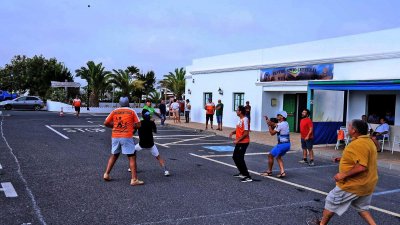
Last Saturday, the XLVII pelota match of the Socorro 2025 festivities was held in Tiagua. It was a match with many anecdotes, such as the fact that the punch was not made, to which many players who no longer played attended, with the commitment to continue (good sign), it was played with the boat that was used in 1978. The pelota game brought together players from different places in Lanzarote, most of them from Tiagua and Soo, as these are the towns where the largest number of people currently play hand-pelota.
Also present was José Cáceres, an octogenarian player from Soo, one of those players who back in 1978 participated in the first Socorro match. These players act as a good man, a figure that exists in the game of hand-pelota as there is no referee, any doubt that arises in the game is consulted with him, and his decision is respected.
Another curiosity is that for the first time players from the north of the island come to participate; one of the participants from Haría, the player and enthusiast of hand-pelota, the young Darío Hernández R., a physical education teacher, made a boat and teaches it in his institute, but the great curiosity for the history of hand-pelota is that when he was a child he saw some balls in his grandparents' house and wondered what they were for, and he did not get an answer until now that he learned about hand-pelota.
Hand-pelota before the civil war (1936 -1939) was played throughout the island and now that we are on the eve of the Los Dolores festivities, I will tell you that the players from Haría came to the festival on camels and brought the balls, where they played their matches with the rest of the players from Lanzarote who were in Mancha Blanca at the festival.
Another person who participated was Inma, she did not know much about the game, but we are sure that next time she will not need any explanation, we need people like her to integrate to help with the rescue. To say that women in the past did not participate in the game directly, however, they did suffer the consequences, such as the absence of the husband or boyfriend. Juan Guillen, the player from Yuco, said: it was such a vice that when I went to see my girlfriend and they were playing hand-pelota, I tied up the donkey and did not reach my girlfriend's house. Someday we will have to recognize that gesture to so many women and girlfriends.
The result is the least important thing, the interest would always be to win, but the objective of these matches is the recovery of the game of hand-pelota; what was known in the past for the children, today is the great unknown. The match ended with the A team winning by one chico to zero. It does not mean that the B team did not make any chico, but a characteristic of this modality of pelota is: when one of the matches (teams) makes a chico, it is noted on the stone of the foul and when the other match (team) makes another chico, it is deducted, that is, they would be zero to zero.
While the match was developing, the fans commented and remembered anecdotes from other matches, how long did the match last? The famous punch, whether it was strong or weak, etc. They were playing for 90 minutes, explanations were given to the new players and mistakes were corrected, to avoid those vices in successive matches, summarizing a pedagogical match.
At the end, the person in charge of the Bar of the Socio Cultural venue invited the attendees to a refreshment, where all kinds of comments about the game were heard and they were summoned for a new match in Soo.

Add La Voz de Lanzarote as a preferred Google source.
Stay informed with the latest current news.