
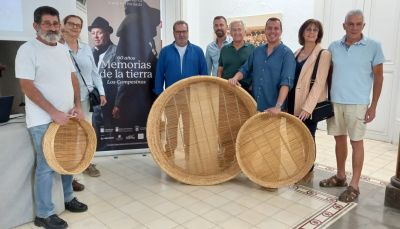
The family of the Los Campesinos Folk Group, on the occasion of its '60th Anniversary', continues with the program they have been developing with initiation workshops in manual loom, traditional peasant music and peasant clothing. Last Thursday afternoon, 'Encounters for Dialogue' was presented at 7:00 p.m. at the Agustín de la Hoz House of Culture in Arrecife, a series of talks that will be given by experts in different sections related to traditions.
The first of the talks related to 'La Zaranda', was given by Julián Rodríguez, the person who, due to his commitment to cultural identity, has led him to be interested in traditional music, children's games, popular festivals, water signs, songs, sayings and proverbs, gastronomy, water behaviors, archeology, ethnography, toponymy, documentary sources, among other issues. In recent years, Julián Rodríguez has focused more on traditional handicrafts of vegetable fibers, with which, when many of the artisans disappeared, he has had to resort to what he calls "archeology of experimentation." A way to know the intricacies of this community art to capture and document it with the aim of not disappearing.
Making use of the slides, the artisan explained to the attendees how the elaboration of 'La Zaranda' is carried out, which dates from the decade of the 70s. A profession that disappeared with the arrival of tourism, leading to the abandonment of agricultural work.
'La Zaranda', as a farming tool, ceased to be necessary, although some are preserved as museum pieces and those that the Los Campesinos Folk Group proudly displays, as Rodríguez explained, since for them it has become a symbol of identity. To carry out the elaboration of 'La Zaranda', a meticulous process is carried out, starting with the preparation of the rush and rye, vegetable material to which almond arches must also be added, in order to give it the round shape and give it strength, in addition to being able to carry out the work that was formerly carried out in the eras of Lanzarote. In a survey carried out on a few men and women of several generations, they were asked if they knew what use 'La Zaranda' had, which many did not know and others answered that it was a dance by Los Campesinos.
Julián Rodríguez, a great connoisseur and lover of traditions, concluded his interesting talk with the following reflection: "craftsmanship is not only manual work". The hands, in addition to work tools, are the sensors of humidity, heat, flexibility and elasticity of the material with which one works. The hands transmit to the brain and the brain at the same time emits orders to the whole body and especially to the hands. The hands have no memory. There are no handyman people, is it said of a painter or a sculptor that he is a handyman, being his own hands work tools? While we continue to relegate crafts to the Wednesday afternoon markets and it is not exhibited in the art rooms, we will continue to undervalue the common art of an entire town, which for thousands of years has been able to maintain the artisans.
To conclude, the very grateful audience said goodbye to Julián with their applause, positively valuing his intervention.


