
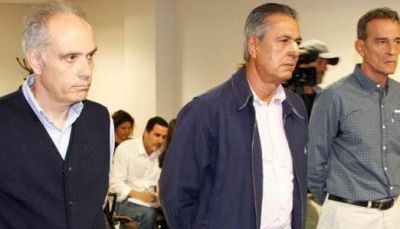
The judge of the Court of Instruction number 3 of Arrecife, José Luis Ruíz Martínez, has ordered the opening of oral trial in the Costa Roja case, which will once again seat the former mayor of Yaiza, José Francisco Reyes, the former secretary, Vicente Bartolomé Fuentes, and the former head of the Technical Office, Antonio Lorenzo, in the dock for urban planning prevarication crimes in the granting of that license.
In addition, the order gives the three defendants 24 hours to hand over a bail of 3,960 euros each, to ensure the payment of the fine to which they could be sentenced. In its indictment, the Prosecutor's Office asks that this fine be imposed on them, as well as that they be disqualified for three years and three months. For its part, the popular accusation, exercised by the former general secretary of the PSOE on the island and councilor of the Cabildo, Carlos Espino, raises the request to one year and three months in prison and seven years of disqualification, considering that it was not a single crime of prevarication but a continuous crime. And it is that a year after granting the building permit, the defendants also approved the execution project, despite the repeated warnings they had already received from the Cabildo about its illegality.
The order ordering the opening of oral trial warns that in the event that the defendants do not deposit the bail, their assets will be seized until that sum is covered, or their insolvency will be declared if no properties are found in their name. In addition, it orders the referral of the proceedings to the Criminal Court that corresponds in turn, which will be in charge of prosecuting the case.
The plot that later gave rise to the Unión case
The events occurred almost 15 years ago, when José Francisco Reyes granted the Costa Roja license, which authorized the construction of more than 1,000 homes, 228 commercial premises and 2,559 parking spaces at the entrance to Playa Blanca. This same plot was the one that later gave rise to the Unión case, when Luis Lleó tried to bribe Carlos Espino to try to unblock this project, since the license had been appealed in the contentious-administrative way by the Cabildo and also denounced in the criminal way by Espino himself.
However, while that piece of Unión was already tried and convicted more than a year ago -with Lleó's confession-, this previous procedure had been paralyzed for years in the Court of Instruction number 3 of Arrecife, during the stage of Judge Rafael Lis. When this magistrate retired -who had links with Juan Francisco Rosa and was sanctioned for having continued to intervene in a procedure in which he had been challenged for that reason-, the judge who replaced him resumed this and other cases that had been delayed for years in his Court.
Precisely that delay in the instruction led the Prosecutor's Office to considerably reduce the penalties it requests, when last November it presented its written statement of qualification. In that writing, it points out that “extraordinary and undue delays” have occurred, since “the processing of the procedure was paralyzed, without any resolution of a substantive nature being adopted in it, from March 14, 2013 to November 7, 2019”, coinciding with a good part of the period in which Rafael Lis was the head of the Court.
The repeated 'modus operandi', with reports empty of content
It was on August 31, 2006 when Luis Lleó, on behalf of the entity Residencial Costa Roja SL, submitted the application for a license for this macro-project that he intended to carry out at the entrance to Playa Blanca. Only 13 days later, the secretary, Vicente Bartolomé Fuentes, issued a supposed legal report in which, according to the accusation, “he limited himself to listing legal precepts”, but without referring to the specific project on which he was reporting, and which contravened the legality.
Two months later, the other defendant, Antonio Lorenzo, issued his report as head of the Technical Office. And according to the accusation, he did so “in order to give the appearance of legality to the authorization of an illegal project and decisively contributing to the granting of the license by the mayor”. Again, he points out that in that report he limited himself “to speculating on alleged reasons why the project could fit, deliberately and crudely obviating to pronounce on the manifest illegality of the same”. Both Lorenzo and Bartolomé Fuentes have already been convicted in other cases for a similar 'modus operandi', which consisted of issuing reports empty of content, on which Reyes later based himself to grant the licenses.
Finally, 20 days after having that report, the mayor granted the permit, completing in three months and five days the file to authorize the construction of a macro-project that would have multiplied the population of Playa Blanca, since it implied more beds than inhabitants Tinajo had at that time. In addition, they did so by hiding the license from the Cabildo, which was revealed in its day by La Voz de Lanzarote, and later ignoring the warnings they received from the Island Corporation, to which they were obliged to have requested a report.
Despite these warnings, the three defendants continued and not only did not annul the building permit that Reyes had already signed, but also processed the execution license. And in this case they resolved it in a single day. On June 8, 2007, Antonio Lorenzo issued a technical report, Vicente Bartolomé a legal report and Reyes granted the license.
The Island Corporation then appealed this permit in the contentious-administrative way, obtaining precautionary measures that allowed the project not to be executed, although it finally did not take criminal action. Who did so was the then councilor Carlos Espino, with a complaint that is what gave rise to this cause, and which will now return to seat the former mayor and two of the technicians who have already been convicted with him in other proceedings in the dock.
In the case of Reyes and Bartolomé Fuentes, they even confessed in the Yate case that they had granted licenses knowing of their illegality, and the former mayor also acknowledged that he had done so in exchange for bribes from different businessmen. As for this case, initially a crime of bribery was also investigated and Lleó himself was charged, but the charges were finally dropped as there were no “sufficient indications” of the payment of a bribe in exchange for the granting of that illegal macro-license.


