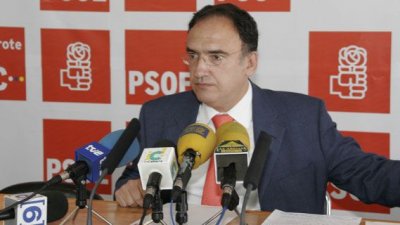
The proposal of the Socialist Party (PSOE) and the Popular Party (PP) in the Canary Islands to reform the triple parity system has caused great upheaval in Lanzarote. The situation has reached the extreme that the members of the PSOE of the Island have shown their rejection of this change, even positioning themselves against the guidelines set by their regional party.
This was stated yesterday by the general secretary of the formation in Lanzarote, Manuel Fajardo, when assuring that his duty "is to defend the interests of Lanzarote" since "the only thing left for the small islands is this differentiating factor".
Social cohesion
The first argument used by the socialists of Lanzarote to defend their position is that the Statute of the Canary Islands, approved in August 1982, was established as a formula for social cohesion "in which the factor of territorial weighting prevails over the population", pointed out Manuel Fajardo.
In this same line, the general secretary explained that the territorial factor also has more weight in article 69 of the Constitution "since the Canary Islands elect more senators than Madrid", concluded Manuel Fajardo.
Secondly, the PSOE of Lanzarote points out that the Island is affected by the fact of double insularity "which implies differences in aspects such as education or health", said the general secretary, who also pointed "to the bad example of the budgets" of the autonomous community that for twelve years have been "an inclemency for Lanzarote due to the differentiating effect", commented Manuel Fajardo.
Finally, the Socialist Party considers that it is not possible to break the triple parity system because precisely the differentiating factor is the argument used before the European Union or the central Government to demand more money or that the consideration of the Canary Islands as an outermost region be maintained.
For and against
The Socialist Party in Lanzarote demands that both its colleagues and the rest of the parties explain to them what fact underlies the modification of the Canarian electoral system and "give us a single reason for the benefits because I cannot find them", assured Manuel Fajardo.
Meanwhile, the PSOE on the Island will work to ensure that the proposal does not become a reality. It must be taken into account that the change of the electoral system is to be included within the reform of the Statute of Autonomy that is expected to be concluded in the second half of January for its referral to the Courts.
Parliamentary consensus
In this way, Manuel Fajardo assured: "The only formula that fits from the position of the socialists of Lanzarote would have to be done, as our national secretary points out, from the parliamentary, institutional and social consensus".
For this, Manuel Fajardo used as a simile that the PSOE managed to get the president of the Government not to allow oil exploration until there is consensus, so "he will not cease in his efforts to try to convince with words and reasoning that this proposal be withdrawn", assured the general secretary of the formation in Lanzarote.
The discussion around the modification of the triple parity system also implies the confrontation of the Socialist Party with the Canarian Coalition (CC). On this aspect, Manuel Fajardo assured that they are not willing "to a double language since we are publicly expressing a difference with our regional party and we demand that the Canarian Coalition do the same".
Thus, the general secretary of the socialists on the Island considers that the nationalist formation has to make its position clear. On this same line, Manuel Fajardo pointed out that it has been the Socialist Party that has had to convene the extraordinary plenary sessions against the reform of the electoral system in the municipalities of San Bartolomé and Yaiza "perhaps because they have some kind of interest in not doing them", explained Manuel Fajardo, who in this way wanted to emphasize the fact that the mayors of these two municipalities belong to parties that once formed part of the Canarian Coalition and perhaps with the change they could be somehow benefited.
In agreement on the reduction of electoral limits
On the proposal of the socialists and popular from the PSOE in Lanzarote they only agree with one aspect. In this case it is the reduction of electoral limits, that is, the minimum percentage of votes that parties must obtain to have representation in Parliament. Currently the percentages are 30% in each island and 6% in the Canary Islands. The change would mean reducing these figures by half.
Finally, the general secretary of the Socialist Party on the Island assured that there is only one possibility to carry out the reform. In this sense, he indicated that the only possibility is that the citizens of the smaller islands have equality with the inhabitants of Gran Canaria and Tenerife.
Add La Voz de Lanzarote as a preferred Google source.
Stay informed with the latest current news.