
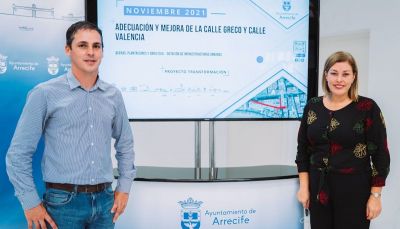
The Arrecife City Council presented this Thursday the remodeling project for El Greco and Valencia streets, which aims to "prioritize pedestrian accessibility over vehicles" and will involve the elimination of half of the parking spaces and the reduction of speed to 20 kilometers per hour.
In both streets, the "single platform" will be used, in which there is hardly any difference in level between the sidewalks and the road, except for "a two percent slope where the drains for rainwater drainage will be installed." With this, the City Council affirms that it will end "with the filtrations that occur to the adjoining buildings in times of rain."
El Greco street will have sidewalks that alternate from 1.90 meters to 2.68 meters wide, depending on the building line, while the parking spaces will be 2 meters wide and the traffic lane will be 3.00 meters. Thus, one of the parking areas will have to be eliminated and parking will only be allowed on one side of the street.
For their part, the sidewalks of Valencia street will have dimensions of 2.47 meters wide, and 3.00 meters for the circulation of vehicles, while El Callejón pedestrian street, which has an exit to Avenida Fred Olsen that borders El Reducto beach, will have a width of 2.30 meters.
The Arrecife City Council adds that the circulation of cars will be limited "to 20 kilometers per hour" as a maximum, since it is established as a "residential use" area. In addition, they add that the pavement "complies with the regulations for the use of people with reduced mobility", and the location of devices for "bicycle parking" is also contemplated.
The work, whose deadline for submitting tender offers ends on Monday, November 29, has a budget of 369,349.97 euros, an execution period of 4 months, and will involve "the planting of trees, placement of street furniture and the installation of new public lighting."
Rainwater and irrigation network
From the City Council they point out that the works, "despite not having technical difficulty that may delay its execution or increase its budget, contemplate the demolition of the existing pedestrian pavement and the wearing course, the installation of public lighting, irrigation and rainwater network, gardening and renovation of road signs and luminaires."
"We intend to turn the seafront of El Reducto Beach into a growing area for economic, recreational and leisure activities of the city, thinking, as always, about mobility and compatibility between cars and pedestrians," said the mayor at the press conference.
According to the Consistory, El Greco, El Callejón and Valencia streets present "a deterioration that has been gradual over time, without having been repaired in years." "Hence, it is the objective of the current municipal Government group to develop the basic conditions so that these roads are accessible to all types of pedestrians," added the mayor.
With these works, the City Council maintains that the streets will have "a unique typology, that there will be practically no difference in level between the sidewalks and the road, and that priority will be given to pedestrians over vehicles." In addition, they defend that these actions "will turn the area, thanks to the increase in businesses oriented to tourism and the existing restaurant offer, into one of the areas of greatest economic growth in the capital."
Finally, from the Arrecife City Council they have added that with the design of the new irrigation network it is intended to "provide hydric stability to the new trees that will be in the area, mainly species such as Cheflera Bicolor or Eugenia Myrtifolia."


