
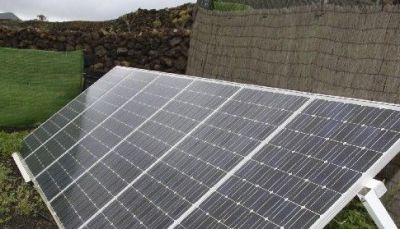
The progress document of the new Island Planning Plan (PIO) enables the creation of solar energy production parks in areas that affect Tías, San Bartolomé and Arrecife and three more locations for solar plants in rustic protection land next to Playa Blanca and Tinajo. Regarding solar energy, the Plan says that "on the rooftops of Lanzarote a surface of more than 8.5 million square meters has been measured where photovoltaic devices could be installed".
Taking advantage of that surface, "the current production of the thermal power plant could be tripled, and exceed 700 megawatts, avoiding the emission of nearly one million kilos of CO2, although it recognizes that "however, materializing this potential fully is complex due to the atomization of the property", which makes "necessary to also consider larger-scale actions, applying industrial solutions".
Regarding wind energy, the Plan speaks of the importance of ensuring public control over energy resources through competition systems, such as wind power. It proposes three new locations: two of them in the municipality of Haría (one in Tabayesco and another next to the Tenigüime ravine) and the third in Montaña Mina.
The progress indicates as one of its medium-term objectives, without specifying the number of years, that of reaching a generation of renewable energy over the total consumed on the Island of 50 percent. The document says that "dependence on the outside causes economic problems, by depending on the evolution of prices in world markets, security in supply and environmental impact due to emissions".
The objectives set in terms of energy production, in addition to achieving maximum self-sufficiency by replacing fossil fuels with renewables in the largest possible proportion, are to promote the use of clean energy in industrial and agricultural activities, ensure synergies in the energy supply to desalination plants, make large initiatives compatible with those of a domestic scale or limit energy consumption in transport thanks to the mobility model proposed by the Plan.
The Plan, however, contemplates the expansion of the Punta Grande thermal power plant "in an exceptional and justified manner, to solve the immediate needs of electricity generation" and also reinforce the main electrical corridor of the island, including the connection with Fuerteventura, to increase its voltage to 132 kilowatts, as well as the expansion to the north and the creation of the Teguise?Haría electrical substation.
Other actions contemplated in the Plan are the creation of a mini-hydraulic power plant in the Mala dam and the production of electrical energy from the waves, with facilities associated with sports and commercial ports, in addition to the energy recovery of waste in the Zonzamas environmental complex.
Dependence
Lanzarote's energy dependence on the outside is estimated at 97 percent, consuming more than 400,000 tons of oil annually. Of these, 45 percent is dedicated to electricity production (half to desalinate water), 22 percent is destined for automotive and the remaining 33 percent to air and sea transport. In addition, Lanzarote's energy consumption grows by 7 percent each year, above the regional average.
S.G. / ACN Press


