

PHOTOS: Sergio Betancort
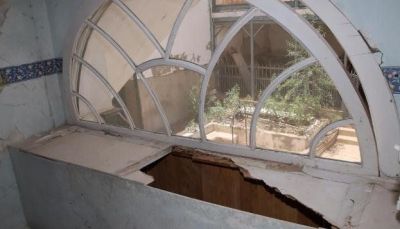
Six years after the previous president of the Cabildo decided to buy the Fermín house, located on Fajardo Street, the main building not only remains closed, but has also suffered serious deterioration due to lack of maintenance. This has been verified by La Voz de Lanzarote, which more than five years after this controversial purchase has re-entered the property, which shows decay in each of its rooms and corridors.
The first thing that catches the eye is not even the walls ravaged by humidity, the broken wood or the holes in the ceilings and on the floor - the result of the surveys carried out more than five years ago - but the absence of any trace of the restoration works that had been announced, and which were finally awarded almost a year ago to Tragsa for nearly one million euros.
At that time, the Cabildo acknowledged that the project to transform the house into an Archaeological Museum could not be executed, because the Arrecife General Plan did not allow that use, and explained that they had decided to divide the project into two and at least begin the restoration of the property. However, the reality is that these works, which had a completion period of 12 months, never started, without the previous government group having informed of this or explained the reasons.
Humidity on ceilings and walls and woodworm
In addition, during this time there have been no minimal maintenance interventions required by an old building, which among other things would need annual waterproofing while the underlying problems are not corrected. The result of this abandonment is palpable in every corner of the house, where humidity has emerged on ceilings and walls, in some cases also corroded by the effect of salt. And to this is added the deterioration of the floor, which is affected by wood-eating insects that feed on the wood, and that continue to spread because no treatment has been given either.
The absence of any investment in maintenance is reflected in a report prepared by the Heritage area, which details the expenses incurred in the property since its purchase in 2013. According to that report, since then there has already been a disbursement of more than 2.6 million euros of public money between the purchase, the drafting of projects and the interventions in two small side warehouses - which are the only ones that have been adapted and opened to the public - but the main part of the building was left in abandonment.
In fact, that list of expenses reflects that payments for maintenance work were only made in the year following the purchase. Specifically, in 2014, 5,849 euros were paid for waterproofing, 6,544 for conservation and 2,632 for a "comprehensive cleaning project". But that was in 2014 and since then, there is no record of any further investment in the main building, where dirt also accumulates and where a part of the structure, visible from the backyard, continues to be propped up.
Almost one million euros already paid to Tragsa
However, the Cabildo has paid almost one million euros during this time, and most of it has gone to Tragsa, with direct awards signed by the former president, Pedro San Ginés, in some cases despite the legal objections raised by the Intervention area.
The first order to Tragsa, worth 260,093 euros, was for the preparation of the restoration project and the museum project that has not been executed, because the planning does not allow the use for which they bought the house. Afterwards, a second order was signed to intervene only in the two side warehouses, "for their use as a temporary exhibition". Initially, that work was awarded for 398,845 euros, to which another 26,318 euros were added for the "contracting of the work management, optional work management and electrical installation management".
However, two modifications to the project were later approved. The first raised the budget to 38,427 euros more, but even so Tragsa again claimed that it was "impossible to complete the works with the budget allocated for it". For this reason, the 463,590 euros that had already been approved ended up being used only for one of the warehouses and for the other a new direct award was made to Tragsa for another 168,283 euros. Thus, in total this company dependent on the Government of the Canary Islands has already received 891,966 euros only for the drafting of the project that has not been executed and for the conditioning of the two side warehouses.
At least 2.3 million euros would still need to be invested
Regarding the intervention in the entire building that is still pending, it was budgeted at more than 2.3 million euros, although the project was drafted five years ago. In this way, in case the figures do not skyrocket again as happened with the side warehouses, the total cost including the purchase of the property would reach 5 million euros. However, there is still no date for the execution of that museum project and not even that first part of restoration has begun, which was also awarded to Tragsa for 981,769 euros.
Regarding the rest of the expenses that the Cabildo has faced so far, the surveys and technical studies on the state of the building are also included, which were not carried out until after the purchase. These studies, according to San Ginés later acknowledged, detected "hidden defects" in the property, with which he justified that the work was going to end "much later than he expected" and "at a higher cost".
Precisely this absence of prior reports was already denounced at the time by the opposition, when Pedro San Ginés carried out the controversial purchase of this house, which belonged to the family of who was then his partner. "I am fully convinced that with the perspective that distance gives, it will be considered one of the best decisions from the investment point of view that the Cabildo has made," the president defended at that time. However, six years later, not only has the museum not seen the light, but the house, whose purchase was defended for its historical value, has been deteriorating and seeing how those "hidden defects" warned by the reports emerge, since there has been no intervention either to correct them or to carry out minimal maintenance.


