
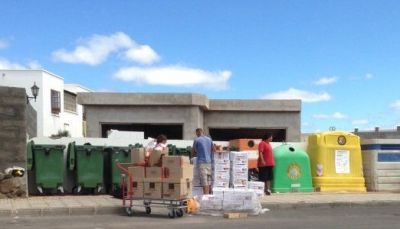
The Councilor for Social Services of Yaiza, José Antonio Rodríguez, has acknowledged this Wednesday that the food for needy families that was thrown into garbage containers in Playa Blanca this Tuesday was in a warehouse of the City Council. Although this Tuesday Rodríguez told La Voz that he had no knowledge that food was being thrown away, a day later he has acknowledged it and has also admitted that the protocol for it was not followed, alleging that it was a decision that was made "on the fly".
"It is true that the protocol is that you take it whole, put it in the truck and take it to the landfill," said the councilor, who says that depositing it in containers was a "reaction of the workers, for fear that the rest of the food would be contaminated." According to him, "about 12 boxes of pasta and half a pallet of rice had been filled with weevils", something he justified by saying that "the heat, in summer, for grains and legumes" is something "criminal". According to him, the City Council has already notified a company to fumigate the warehouse "just in case". "You don't see those bugs until they appear," he adds.
Rodríguez, who maintains that he did not become aware of what happened until after this media contacted him on Tuesday, has also tried to link the Red Cross. "15 days ago or so, according to the social worker, the Red Cross was notified to remove them, so I see that the Red Cross now does not have personnel or has little personnel, the case is that when they realized yesterday (for this Tuesday) on the fly, about 12 boxes of pasta and half a pallet of rice had been filled with weevils," Rodríguez insisted. However, the NGO denies having any kind of relationship with what happened. In fact, the Red Cross delivers food to some city councils precisely so that they can get it to families and that is where their work ends.
In addition, in this case the lots that ended up in the garbage this Tuesday come from the 2013 Plan for Food Aid to the Most Needy People of the European Union. This plan distributes through the Ministry of Agriculture and the food is delivered to the city councils so that they can get it to families through the Social Services area. "As soon as they arrive, the Red Cross is notified to remove them and distribute them, there is usually no food in deposit," insists the councilor, who nevertheless ended up pointing out that he does not know the procedure, when asked for more details about that supposed intermediation of the Red Cross. "I am new to the Councilorship," Rodríguez argued, adding that he "imagines" that there will be a protocol.
"The responsibility lies with the entities"
For her part, the island president of the Red Cross, Alicia Martín Borreguero, explained this Wednesday that the food from the European Union "is delivered to different entities", among which there are "associations, groups and city councils", such as that of Yaiza. "The responsibility for the food that is given to them lies solely and exclusively with the entities that collect it," said Martín, who stresses that "the Red Cross does not manage it once it leaves its warehouse."
The president of the NGO also emphasizes that, before the first delivery, all entities receive "a guide explaining the procedures to follow and several meetings are held so that they are aware of how they have to do things." "Really, the entities have to know perfectly how the procedures are followed, because it is a very sensitive and very important issue as times are," she stresses.
As for how to dispose of food in case there is a batch in poor condition, Martín Borreguero explains that it must be done through an approved company, as the councilor has also admitted, and not the City Council or the NGO. "The transport cannot even be done by the City Council, it has to be the European Agricultural Guarantee Fund that facilitates the contact of an authorized carrier," explains the president of the Red Cross. That authorized carrier would then be responsible for taking the products to the landfill.
In addition, when throwing away food, it is necessary to indicate how much food is thrown away and for what reason. In this sense, José Antonio Rodríguez points out that "the social reports are done" and that "the social worker did them on the fly". As for how to proceed to take the food to Zonzamas, he says that he told the worker "what the protocol to follow was, but they are reactions on the fly".


