Photos: Sergio Betancort
The Cabildo has opened the first two rooms of the Archaeological Museum of Lanzarote, which are located in the lateral naves of the emblematic building on Fajardo Street, in Arrecife.
Pedro San Ginés, president of the Cabildo of Lanzarote, and Isaac Castellano, Minister of Culture and Tourism of the Government of the Canary Islands, together with the general director of Heritage, Miguel Ángel Clavijo; the president of the Board of Directors of the Tourist Centers, Echedey Eugenio; and the Councilor for Historical Heritage of the Corporation, Carmen Rosa Márquez; among other authorities, were responsible for inaugurating the first phase.
This is an "identity" project, said the president, in which visitors to the island "will also be able to find the signs of the place to visit", enriching in this sense not only the knowledge of the resident population but also the experience of those who visit the island. It is also "an obligation of local corporations to protect, conserve and disseminate all this heritage to bequeath it to the future", stressed the president of the Corporation. Not in vain - he continued - Heritage has been one of the great bets of the Cabildo in this legislature, with the Site Museum and the Zonzamas site, that of Fiquinineo and San Marcial del Rubicón, the recovery of the Salinas del Risco and Naos, one already being restored and the other in project, the restoration of two Mills, through subsidies, the purchase of another abandoned Mill such as Cabo Pedro to restore it, among many other actions in progress. "An unprecedented, firm and determined commitment in this legislature, as never before, with our heritage," he stressed.
During his speech, San Ginés also maintained that they are "very proud and satisfied" with the result of this project and the first phase, which he described as "extraordinary" and the future of the Museum, which "will also be, despite the hidden defects that the house had and other bureaucratic problems that affect its intervention, such as the catalog of the Arrecife City Council that does not allow today to rehabilitate, but to restore, among others".
Finally, the president wanted to especially thank the Government of the Canary Islands, and its president, Fernando Clavijo, for their support for this museum project, as well as the Minister of Culture and Tourism, Isaac Castellano, and the general director of Heritage, Miguel Ángel Clavijo, for the involvement and commitment they are also making with regard to the enhancement of the island's heritage of Lanzarote.
Likewise, the president conveyed his thanks to the Councilor for Heritage of the Cabildo, Carmen Rosa Márquez, and to the entire technical team of the department for the "intense work and effort" made in making this project a reality, as well as to the Tourist Centers and its councilor, Echedey Eugenio, who by order of the Cabildo of Lanzarote will manage this space.
The president made a special mention to Don Juan Brito, favorite son of Lanzarote, "one of the great custodians of heritage, perhaps the greatest, innately, self-taught and wherever he is, he will surely be very happy and will sport a smile, wise and mocking, like the ones he gave us".
Finally, the president did not want to miss the opportunity to also thank the Manrique de Lara family for the generosity and patience they have had, as well as convey their "apologies for the trance that they have been made to go through in such a miserable way in these years. I urge them to forgive those, poor in spirit and lacking in principle," he said.
For his part, the Minister of Tourism, Culture and Sports of the Government of the Canary Islands, Isaac Castellano, stated that "opening the doors of this museum means guaranteeing citizens access to culture and heritage assets. It means turning into a reference something that represents what we are, where we come from and what our history is, the history of Lanzarote".
As he explained, "this is a public institution whose objective is to offer society a rigorous, attractive and critical interpretation of the past, and to provide added value to the island as a tourist destination."
After visiting both naves, the event concluded with a tour of the interior of the house, the future headquarters of the Archaeological Museum of Lanzarote that will be put into service in a second phase of the project.
The Archaeological Museum of Lanzarote
The Centers for Art, Culture and Tourism have assumed the management of the Archaeological Museum of Lanzarote by order of the Island Council.
The installation is articulated around two lateral naves, inaugurated on Thursday night, which occupy a global surface of 275 square meters, and the house, which will be opened in a second phase.
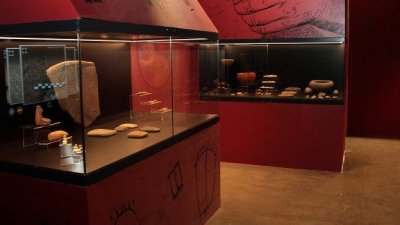
The first of the naves, located to the left of the facade from the outside, is the anteroom of the Archaeological Museum of Lanzarote. Since this Thursday, it hosts a permanent exhibition with some of the most important archaeological pieces of the culture of the majos present in the inventory of the Cabildo, such as, for example, the well-known aboriginal piece 'La Estela de Zonzamas'. In addition, visitors can enjoy pieces of ceramics, tools made of stone, bone or horn and objects of adornment and ritual.
This space has the latest technology applied to museum spaces such as virtual reality, which will give visitors the opportunity to feel like a member of an archaeological excavation; touch screens, which show different sites of cave paintings, and 360-degree images, which will facilitate the possibility of making a virtual visit to different archaeological sites. Another of the spaces in this room is dedicated to the buried history, in which the incidence of natural phenomena in the research on the past of the island is revealed, emphasizing the volcanic eruptions and the advance of the jable, which have covered more than half of the island in recent centuries. This explanation is accompanied by a display case that exhibits elements recovered in the excavations carried out in the Peña de Las Cucharas (Fiquinineo).
Underwater archeology is also present with the explanation of the interventions carried out in this regard and showing some of the objects found in the seabed of the island, such as amphorae, cannonballs and a pipe. There is also a special section dedicated to explaining the attacks of the pirates that the island suffered between the 14th and 18th centuries. In addition, the room contains a copy of the book "Le canarien", written by the Normans upon their arrival on the island, in which the conquest of Lanzarote is narrated.
Room A also contains one of the jewels of the island's historical heritage: the mummy of an ancient inhabitant of Lanzarote. And the world of death of the majos is one of the great enigmas of island archeology due to the lack of verified and cataloged graves. This is probably due to the great geological transformation that the island has experienced in its most recent history due to volcanic eruptions and the invasion of jable in the 18th and 19th centuries.
Room B
Educational workshops, talks and conferences and courses on heritage will be held in the second nave. In addition, it is planned to host temporary exhibitions.
For the inauguration of the Museum, an exhibition dedicated to the house on Fajardo Street 5 has been installed, as a heritage asset of Arrecife, to the family that executed it, and to the historical context in which it was built.
In this room, visitors can enjoy Arrecife, an architectural heritage to discover, a very interesting tour of the elements and constructions of greatest interest and architectural value of the capital of the island.
The Archaeological Museum of Lanzarote can be visited from Tuesday to Friday from 10.30 a.m. to 5.00 p.m., and Saturdays from 10.30 a.m. to 2.00 p.m. The entrance fee will be 3 euros for the general visitor, and 1 euro for the island resident, although admission will be free until January 8, 2019.

Add La Voz de Lanzarote as a preferred Google source.
Stay informed with the latest current news.