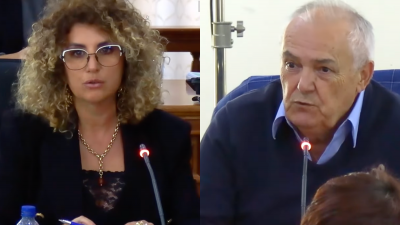
Vox has managed to pass a motion to prohibit access to the headquarters of the Arrecife City Council and other municipal spaces for Muslim women who use the burka or the niqab, headscarves that totally or partially conceal the face. With the support of the Popular Party and the abstention of Coalición Canaria, this initiative has prospered despite having been described as "racist, xenophobic and stigmatizing" by the Socialist Group and the reluctance of the CC spokesperson in the City Council, Maite Corujo.
The approval of this initiative occurred on the same day that the far-right formation prevented an institutional declaration from going ahead, with the support of all political groups that make up the Arrecife plenary, in support of Women's Day, which is celebrated next March 8.
In the initiative presented by the far-right party, which is based on "security reasons", there is no allusion to women in general, nor to Muslim women in particular although the measure is aimed at this group. Furthermore, reference is made to the use of the niqab or burka specifically and it is generalized to "other similar garments of equivalent effect".
Among the measures approved at the request of Vox, the plenary has committed to establishing an access system that identifies the faces of those who enter municipal buildings. "It is not an issue of our own, they are not going to restrict citizens' access, with the exception of people who have this link in religious matters," Eugenio Hernández added during his speech.
In this way, Vox and PP have supported entrusting the legal services of the municipality to draft and approve "a regulation or internal rule" for the use of municipal facilities.
The initiative has generated confrontation between the different political parties. From the Government Group itself, the spokesperson for Coalición Canaria, Maite Corujo, also Councillor for Social Welfare of the City Council, has defended that this debate should not have been brought to a municipal plenary session.
"Who are we to prohibit a cultural and religious element?" defended Maite Corujo, who pointed out that this prohibition means "overstepping" the institution's functions. "This is the house of the people, of the people in their globality," she insisted.
In view of this, the Vox councilor in Arrecife Eugenio Hernández Cabrera has defended the motion recognizing that they are "garments without roots in Spain".
In this regard, the nationalist councilwoman has indicated that there are other identification measures that do not involve prohibiting a particular garment. "A woman who is covered in an airport has to identify herself: she goes to a separate room and uncovers her face before a female agent," said the councilwoman from Coalición Canaria.
Maite Corujo has highlighted that the formation is not in agreement with the motion and that her concern lies in the importance of giving a voice to those women who are forced to cover themselves "without wanting to do so", "because there we are talking about establishing rights or imposing on women something they do not want to do".
Meanwhile, the spokesperson for the Socialist Group, Alfredo Mendoza, has defended that the measure that Vox wants to sell as "security or freedom for women" is a "slamming of the door" on citizens' rights and becomes "open bar for arbitrariness". Thus, he has indicated that "it stigmatizes a minority through a general prohibition disguised as a municipal rule".
"What real problem has occurred in Arrecife to justify this text?", Mendoza has questioned, who has pointed out that "if there are no data it is not about management, but about propaganda because there is no foundation."
Mendoza has shown himself open to debating "in a serene, thoughtful and calm manner" about the burqa, but has refused to accommodate an initiative "racist, xenophobic" and that "stigmatizes a minority, seeking solely and exclusively to stir up hatred".
"Today they start pointing out a burka, tomorrow a veil and the day after tomorrow they start pointing out other issues," the socialist has warned.
Facing this, the Popular Party councilwoman Eli Merino, has pointed out that from her formation they appeal "to the security of our country, to the identification of the people who enter public institutions".



Add La Voz de Lanzarote as a preferred Google source.
Stay informed with the latest current news.