
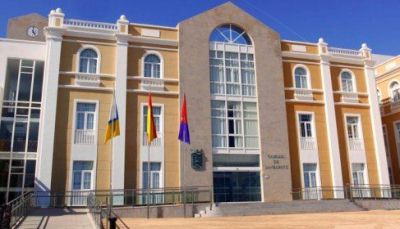
"The Ministry of the Environment allows Repsol to carry out aggressive interventions for the oceanic environment in the same area where the Spanish Navy does not carry out military maneuvers due to the damage they cause to biodiversity and, essentially, to species of whales and dolphins protected by international conventions." This was denounced by the Cabildo of Lanzarote through a statement, as it does not understand how, on the one hand, surveys are authorized and, on the other hand, military maneuvers are not allowed.
The Cabildo has recalled that the resolution approved on May 29 by the Secretary of State for the Environment establishes that the oil company's drilling is "compatible", in an area that recognizes "phenomena related to cetacean species as among the highest and of greatest relevance worldwide and that have not been recorded anywhere else in the world".
For the Cabildo of Lanzarote, the compatibility announced by the Ministry of the Environment between Repsol's wells and the protection of this area of international environmental importance, "is not only questioned, but flatly rejected, as it contradicts its own studies and recommendations".
In fact, the Cabildo has insisted that in a "precise and elaborate" scientific report from the Ministry of the Environment, financed with public funds and dated September 2011, it is highlighted that carrying out activities that include the use of active sonars of low and medium frequency and high intensity, especially those used in military maneuvers, oil or gas exploration or exploitation activities, or seismic or oceanographic studies that include such emissions, "should be prohibited".
Whales and dolphins, stranded
This report, according to the Cabildo's statement, is the result of a process initiated in 2004 in which, "after successive years with episodes of whale and dolphin strandings in Lanzarote and Fuerteventura", it was determined the advisability of investigating the relationship of these mortalities with the military exercises carried out by Spain and NATO off these islands.
The maneuvers included the use of low and medium frequency and high intensity sonars, emitting acoustic waves from ships and submarines that swept wide oceanic areas, "seriously affecting the sensitive auditory systems of these animals". "The strandings led to the signing of a first agreement in April 2004 between the Ministry of Defense and the Ministry of the Environment, which was reissued in December 2007 after verifying that the military exercises were indeed linked to the mortalities of cetaceans due to acoustic emissions", the Cabildo has pointed out.
According to these same sources, the Ministry of Defense accepted the conclusions of the scientists, "renouncing to carry out military maneuvers in the area" through a resolution, which established that as long as the permanent habitat areas of the beaked whales are not identified, it committed "not to carry out exercises that involve the use of anti-submarine active sonars and underwater explosions within 50 nautical miles to the west and south of the westernmost islands of the Canary Archipelago". As for the habitat areas that are identified, the Ministry committed not to carry out such exercises less than 50 nautical miles from the outer limit of these areas.
This resolution also includes the importance of promoting "an exhaustive scientific study" to define the critical areas and the conservation measures that should be implemented in the same area where Repsol intends to carry out its surveys, according to the Cabildo. The public cost of the study amounted to 800,000 euros, which were distributed between the Ministry of Defense (300,000), the Ministry of the Environment (300,000) and the Government of the Canary Islands (200,000).
Four years later, on July 27, 2011, the General Directorate of Natural Environment and Forest Policy of the Ministry of the Environment initiated the processing of a minor contract for the "identification of critical areas for cetaceans in territorial waters of eastern Fuerteventura and Lanzarote and proposal of management measures". The general objective was to identify the critical areas for deep-sea cetaceans, especially of the beaked whale family in territorial waters of eastern Fuerteventura and Lanzarote, determining at the same time the management guidelines necessary for their effective conservation.
Results of the report, "deliberately omitted"
The study, according to this statement, was delivered on September 30, 2001 to the Ministry of the Environment but, despite the final recommendations, "after seven years of administrative process between the Ministries of Defense and the Environment, its final results have not only not been valued at all during the recent Environmental Impact Statement that ended up allowing Repsol's operations, but have been deliberately omitted, transgressing the most fundamental principles and obligations of the authority that must ensure the conservation of the environment in Spain", according to the First Island Institution.
On the other hand, and with respect to the recent statements by the Minister of Energy, Industry and Tourism, José Manuel Soria, stating that the Canary Islands will benefit with 300 or 400 million euros from Repsol's operations, the Cabildo of Lanzarote has expressed "its frontal rejection of irresponsible statements that do not correspond to reality and that constitute a new lie of Minister Soria in this conflict".
Thus, the president of the Corporation, Pedro San Ginés, recalls that the current legislation does not contemplate this type of fiscal instruments to any Autonomous Community where mining operations are carried out at sea. "There are values that cannot be bought or sold, one of them is the will of a population and another is the health of the territory where it is located", the president insisted.
In relation to the statements made this week by the president of Repsol, Antonio Brufau, stating that the drilling will be done during the next months, and that "safety is in Repsol's DNA", the Cabildo of Lanzarote has warned that the oil company and its president "are making a serious mistake".
"If we are drafting the allegations to the proposal of Resolution of the Ministry of Industry, and the Rule of Law grants some guarantee that our allegations will be heard and accepted, I do not understand that Mr. Brufau announces that the drilling will be done yes or yes. It is another insult, like his advertising campaign; this challenge now crosses a very serious line, and we will respond therefore in a proportionate and forceful manner", warned the first vice president of the Cabildo, Joaquín Caraballo.


