
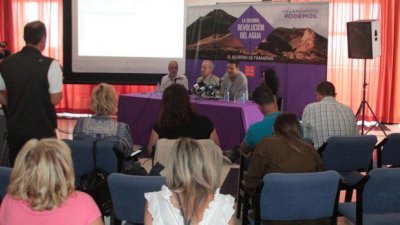
Podemos Lanzarote has announced the discovery of a large aquifer under the malpaís of Timanfaya, which "in the worst-case scenario" could hold up to 17 hm³ per year and cover 70 percent of the island's water demand. The presentation of the discovery was attended by the Podemos councilors in the Cabildo of Lanzarote and the engineer Carlos Soler Liceras, who rose to fame in 2005 after discovering the Fuente Santa of La Palma. Soler, who has received important awards for his hydraulic works and is an official of the Government of the Canary Islands, had been defending for 15 years the hypothesis of the existence of aquifers of water from rain in the badlands of Lanzarote, without his theory having been attended to by the regional government to date.
It was the Podemos group in the Cabildo who contacted this engineer shortly after entering the Island Corporation, commissioning a study that is what has given rise to this finding. The Podemos spokesman in the Cabildo, Carlos Meca, has described it as "a huge natural cistern", which could cover a large part of the island's water demand and will force to "rewrite the books" on the matter published so far and also the Island Hydrological Plan.
As they have explained, the first report commissioned to Soler was financed with the resources of the Podemos group in the Island Corporation. Later, given the need to carry out a more expensive geophysical study, they had the sponsorship of the Cicar group, to which the company Cabrera Medina belongs, and the César Manrique Foundation. Between the two, they covered the costs of that study, which was commissioned to the University of Barcelona, specifically to Albert Casas Ponsati, professor of Geophysical Prospecting and dean of the Faculty of Earth Sciences, whom Soler has defined as "the greatest expert in geology, at least in Spain". And that study is what confirms the existence of a "gigantic mareta" under Timanfaya, as Soler explained.
From a cost of 2.4 euros per cubic meter to 10 cents
Now, he has specified that another study is necessary, which Podemos has already announced that it will demand to be carried out by the Government of the Canary Islands. To this end, it will present a motion in the Plenary of the Cabildo asking that the regional Executive be urged to execute it. Both for that study and for the possible subsequent extraction of water, the engineer Carlos Soler has specified that it could be done taking advantage of the existing roads in Timanfaya, without affecting this protected space.
In addition, he stressed the savings that it would mean for the island, as well as the milestone of no longer depending on oil for desalination. As for the cost, as an example he pointed out that the desalination of one cubic meter of water involves an expense of 2.4 euros, while extracting one cubic meter of that "huge mareta" from the badlands would cost only 10 cents.
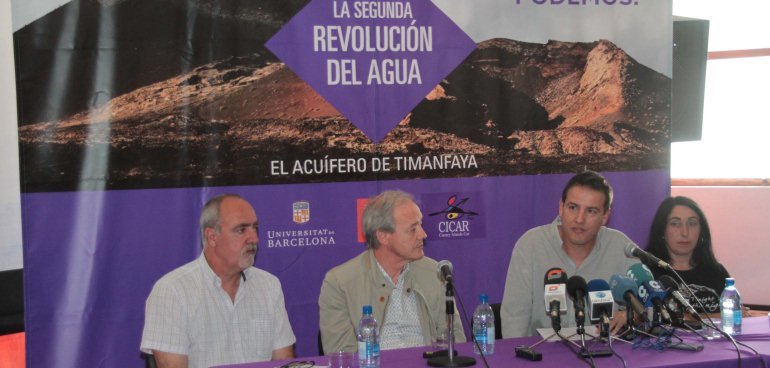
About the study that is still necessary, it would include "a second phase of studies based on soundings and pumping tests to specify both the exact volume of water and the quality of the same". And that study is what Podemos will now demand to be carried out, once "the presence of the aquifer has been confirmed" with the geophysical study carried out by the University of Barcelona.
"A milestone in Lanzarote's history"
"This discovery could be a milestone in Lanzarote's history, which for centuries suffered the hardships of drought years and that since the mid-60s of the last century, with the arrival of desalination, was able to leave behind the misery that entailed the lack of water", says the formation, which has been working for two years on the announcement made this Thursday.
Among other things, it stresses that the collection of these groundwater would reduce the volume of desalinated water production (with the economic and oil consumption savings that would generate) and also offer agriculture a clear alternative to reused water, which has been degrading the lands of the island for years. In addition, according to the report by Carlos Soler, "the benefit of the investment can be enormous", since "even if only 15% of the flow that is demanded on the island is achieved, the savings would be more than 5 million euros per year".
"We may be, therefore, facing a finding of the same depth as what the arrival of desalination plants by the engineer Manuel Díaz Rijo in 1965 meant for Lanzarote", says Podemos, which has dubbed this finding as "the second water revolution". "Fifty years later, another engineer, Carlos Soler, has shown that there is an alternative to desalination to capture groundwater on a large scale on the island, opening a new horizon for the energy future of Lanzarote", they emphasize.
In addition, they emphasize that the engineer Carlos Soler, with a very extensive career and recognition in hydraulic works in the Canary Islands, also confirms "the possibility of extracting water without causing any damage to the environment of the Timanfaya badlands, since the interventions to be carried out can be done on existing roads and without any risk of affecting the landscape".
Two erroneous data "that have been taken for granted until now"
The basis of this discovery is based on the theses that Carlos Soler had been holding for more than two decades. In the first report commissioned and financed by the Podemos group in the Cabildo, the engineer questioned two data that have been taken for granted until now and that were included in the study on water in the Canary Islands carried out by the Ministry of Public Works in the mid-70s of the last century, the SPA-15 project.
On the one hand, that study argued that there is a single aquifer on the island, with brackish and scarce waters. On the other hand, it put the percentage of water evaporation at 89%, concluding that this limited the formation of aquifers in those areas with more permeable soils, such as the badlands. However, Soler's report refutes both assumptions and describes the existence of two aquifers, associated with the badlands of Timanfaya and La Corona, as well as points out, based on his experience in other islands, that the percentage of rainwater evaporation in badlands areas is actually around 50%.
Based on this new scenario, Soler's calculations about the amount of groundwater that may exist in the south of the island range between 12 and 17 hm³ per year. "To understand the importance of the finding", emphasizes Podemos, "it is enough to remember that Canal Gestión Lanzarote produces 24 hm³ per year through desalination, so we are talking about the possibility that the volume of the water bag represents between 50 and 70% of the water that is currently produced on the island".
After the presentation made this Thursday to the media, the formation has already convened an event to publicize this data to the entire island. The event will be next Thursday, June 1, at 8:00 p.m., at the Arrecife Civic Center, and will be attended by the engineer Carlos Soler and the professor Albert Casas, responsible for the geophysical study, and will be moderated by the spokesman of Podemos in the Cabildo of Lanzarote, Carlos Meca.


Add La Voz de Lanzarote as a preferred Google source.
Stay informed with the latest current news.