
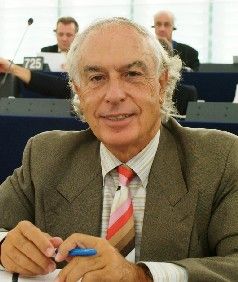
They call it "the tower", but they could also have called it the hive or the labyrinth, because the building where Manuel Medina has his office in Strasbourg, together with another 785 MEPs from the European Union, can be a real trap for those who are not used to walking its enigmatic circular corridors. However, for this Lanzarote native they are like his second or third home. He has been part of the European Parliament for 22 years, from which he will retire in a few months, after the next elections in June. With him, the other Canarian MEP, in this case from the PP, Fernando Fernández, will leave. Both put an end to more than two decades in this institution.
"I have been in the European Parliament for 22 years and five in the Courts, which makes 27 years of parliamentary life. That's enough, isn't it? It's half my life, too much time," Manuel Medina declared a few days ago, confirming that this time he does not intend to be part of the PSOE lists.
But before his announced retirement arrives, La Voz de Lanzarote shared with him a few moments of his day to day in one of the headquarters of the Parliament, which divides its activity between Brussels and the French city of Strasbourg. With him and his assistant, Juan Acedo, who becomes his agenda and his right hand, organizing his time between committees, meetings of the socialist group, plenary sessions and the occasional visit, such as that of two women who came up to three times to his office in search of support for an initiative that they wanted to obtain the support of Parliament.
And in the middle, a first gap to share a meal in one of the restaurants of the European headquarters in Strasbourg. "The rest are open to everyone, but this one is only for the deputies or for the people they invite," he explains as he enters the premises, acting as host in his territory, and having to stop at every step to say hello. Walking with Manuel Medina through the immense building of the European Parliament is witnessing a continuous trickle of greetings as he passes, handshakes or brief chats, depending on the occasion. And all this, in the middle of a great tower of Babel, in which he quickly switches from English to French, German or Italian, as if he were doing it automatically.
A radical turn
After attending to his suggestion of a traditional house specialty dish, and seeing him choose a French wine from the region, it is hard to imagine that child who throughout his childhood knew no borders other than those of Lanzarote. In fact, until he was 16 years old, Manuel Medina did not leave the island, and until he was 21 he had not been to the peninsula. But from there he made the leap to the United States, and then to half the world.
In 1982 he became a deputy to the Congress for Las Palmas and was appointed president of the Foreign Affairs Committee and that is why, as he himself explains, he "had to" make the leap to Europe. And he did it in 1986, becoming an MEP. Since then, he lives between Lanzarote, Brussels and Strasbourg, and with continuous trips to other corners of the planet. In addition to being a member of the Committee on Legal Affairs, he also chaired for seven years the Delegation for Relations with the countries of South America, and is currently part of the Delegation for Relations with the Countries of the Andean Community.
His approach to these regions has earned him medals and honorary recognitions in many of these countries, although perhaps it has also contributed to his work being less known in his native land. However, during the 22 years he has been in the European Parliament, he assures that much has been done for the archipelago.
The role of Europe
"The European Union has always been very good to the Canary Islands," Manuel Medina says without hesitation, recalling the times when the islands had to fight for special aid. And he, of course, has lived it from the front row. Acronyms that are already common, although not always fully known, begin to come out of his mouth, taking on the meaning they have for someone who saw how they were achieved. The Specific Supply Regime of the Canary Islands (REA), the Canary Islands Investment Reserve (RIC), the Canary Islands Free Zones, the Canary Islands Special Zone (ZEC), the Tax on Imports and Deliveries of Goods in the Canary Islands (AIEM)? A whole list of measures that, after recognizing the insularity and especially the remoteness of the archipelago, served to try to compensate for the imbalances and boost economic activity and import and export in the islands.
"Most of the infrastructure in the Canary Islands has been done with European funds," he insists. Perhaps that is why he changes his tone when asked why the issues that come from Europe seem to matter little in the islands. "In Lanzarote, European issues are of interest just like everyone else," he stresses. But why then is participation in European elections so low on the island? Medina has his own explanation: "The censuses are not real. There are people registered who have left the island and have not unsubscribed. I have been able to verify this when we make door-to-door visits during the election campaign."
A paradise
And from Europe, how is the archipelago seen? "People here see the Canary Islands as a paradise," says Medina. "I recognize that it is not a bad place to live." In the corridors of the European Parliament, those who have heard of the islands look at them with some envy, especially because of the contrast with the cold of those lands. Some even ask about "that architect who did so many things in Lanzarote", nodding when they hear the name of César Manrique.
However, and despite the progress that has been made since those times when the Canary Islands entered the European Union, the needs have not disappeared. "They are aware of the problems to the extent that you raise them," explains Medina in reference to his colleagues in Parliament.
"During these years, Lanzarote has undergone a radical transformation of its economy. It has gone from poverty to a very high per capita income," he says, citing as an example the situation of fishing, which "in the 80s was very important because of the issue of agreements", and today "is almost gone".
However, he also points out that there are still pending challenges. "Now the aid to transport, the aid to export are on the table...?" Although those will be issues that remain for those who take his witness in the European Parliament, from which he says goodbye being one of the most veteran MEPs. "It's been many years. I have already done what I had to do."
Passes the baton to López Aguilar
"Honest, hardworking, serious...?" These are some of the adjectives that Manuel Medina dedicates to the person who will become the new Canarian MEP, heading the list of the Spanish Socialist Workers' Party, Juan Fernando López Aguilar. "He likes this a lot," he says to emphasize that, in his opinion, he will play a good role in Europe.
Regarding the criticism that López Aguilar received at the time for running as a candidate to be re-elected secretary general of the party in the Canary Islands, when he was almost packing his bags to Brussels, he says that both things are not incompatible.
"I don't see why an MEP cannot be secretary general of a party," he says. He recalls that for a time, he himself was an MEP and president of the management committee that was created in the Lanzarote PSOE after the departure of Juan Ramírez.


