
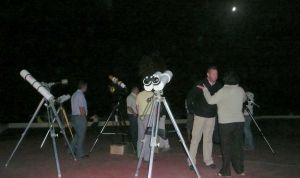
If it were a place that could be freely accessed, mainly at night, the Timanfaya National Park would undoubtedly constitute an excellent astronomical observatory. This was explained on Radio Lanzarote by César Piret, an amateur astronomer who recently took office as a corresponding member of the Academy of Sciences and Engineering of Lanzarote. He is one of the members of the Friends of Astronomy association, which brings together a dozen people who like to see the world -in reality, the universe- through a telescope. Lanzarote was the setting, from July 11 to 13, for the Astronomical Meeting of the Canary Islands, which this year reached its fifteenth edition. And within the framework of this event, which brought important professionals to the island and brought together about fifty astronomers, César Piret gave the conference: "Current state of astronomy. Reflections of an amateur".
Piret's passion for stars, comets and asteroids can be seen with the naked eye, as he has his own observatory, complete with a dome. He is not the only one in Lanzarote, although he recognizes that it is a minority hobby and that it is practiced mainly individually: "Although we have an association, unfortunately there are few of us. The good thing is that, nowadays, impressive work can be done alone."
Being practical, and leaving aside the impossibility of planting a telescope in Timanfaya, César Piret points out that the most suitable places for observations are, among others, Femés and La Geria. There you can combat light pollution, which makes the task of the amateur difficult and which is increasingly present on the island. "Unfortunately, Lanzarote is losing that darkness it had. They are filling the sky with lampposts that only illuminate the clouds, because they are poorly designed," he says.
The wind also makes it difficult for astronomers who decide to look out into the universe from Lanzarote: "It's not that it moves the telescope. It just doesn't let you focus. It makes it vibrate. In July, with this wind, it's better to go to the beach than to dedicate yourself to observation."
Height is also important, as far as astronomical observation is concerned. "To observe, any dark place is fine. The problem we have here is the low altitude. Observatories are usually placed at altitude to remove the thermal inversion layer, which is where the atmosphere is most turbulent, at 1,800 meters of altitude. Everything below that will have a turbulence in the atmosphere that we will not be able to remove. You can enjoy it anyway, but they are not the best conditions," details the new member of the Academy.
Watching the sky
César Piret has been enjoying what he defines as a very beautiful hobby for many years: "For looking so far: putting your eye on a telescope, looking at a galaxy that is millions of light years away... and seeing it, also in time. Right now we can look at the galaxies that are in Virgo. And the light we are seeing, its light, came out when the dinosaurs populated the Earth."
But he explains that it is not just about seeing. Once the hobby is cultivated, scientific curiosity arises. Specific cameras, such as those used by Piret in his observatory in Tías to carry out scientific work, help to satisfy it. Specifically, this "sky watcher" is dedicated to tracking comets and asteroids. "We don't look for them, because it is very difficult, but once located we calculate the orbits and look for the exact position of the object, if it has just been discovered, so that the orbit that is calculated is as accurate as possible and to be able to foresee, for example, if an asteroid is going to fall on us."
Doing science from home
Precisely a few months ago an asteroid was discovered that César Piret was lucky enough to observe on the same day of the discovery: "The measurements I made were sent to the International Astronomical Union and with them they modified the orbit. It was classified as 'at risk of impact with the earth'. I was very excited that my measurements served to refine the orbit. What happens when an asteroid is classified like this is that many more people measure it and when the orbit is refined one hundred percent, one realizes that the possibilities of it impacting against the earth are minimal. Then that classification is removed."
However, on whether we should fear the fall of a large meteorite, César Piret is clear and assures that until 2036 there is no need to worry. However, he affirms that, by probabilities, one will fall. It is reassuring to think that there are many eyes on the sky to know when it will happen.
Appointment with the Perseids
The Friends of Astronomy have their headquarters in the Hotel Lancelot, where the conferences and periodic activities they organize take place. Through the page [www.academiadelanzarote.es->http://www.academiadelanzarote.es/] it is possible to know their proposals. Another possibility is to mark August 11 in red on our agenda. That night, and under the protection of darkness, it will be possible to enjoy a shower of stars. The tears of San Lorenzo will fall with special force that night, although the visit of the Perseids will actually begin on July 25 and will last until August 18. "Meteors are very weak. The more light pollution there is, the less you see," explains César Piret, when recommending the people of Lanzarote to look for dark areas to enjoy this spectacle.


