
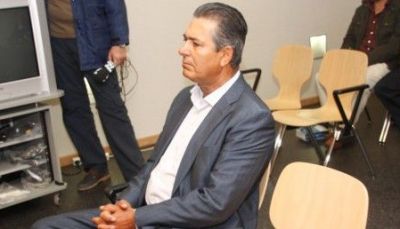
The former mayor of Yaiza, José Francisco Reyes, will return to the dock next Wednesday, June 22, to face another of the trials he has pending, in this case for the granting of nine licenses for the construction of homes on a farm located between Femés and Las Breñas.
In this case, Reyes is charged with three continuous crimes against land management, and the prosecutor is asking for nine years of disqualification from employment or public office. In addition, the City Council secretary, Vicente Jesús Bartolomé Fuentes; the surveyor Alfredo Morales Armas; and the municipal technical architect, Pablo Ramón Carrasco Cabrera, will sit in the dock together with the former mayor.
For Carrasco Cabrera, the prosecutor is asking for five years of disqualification, but also five years in prison. In addition to crimes against land management, the prosecution also maintains that another crime of falsification of a public document was committed.
Homes with a pool on rustic land
The events that will be judged next week by the Provincial Court date back to 1999 and 2000, when, according to the Prosecutor's Office, the Yaiza City Council was authorizing the division of the land and the construction of nine homes on a rustic farm of 12,500 square meters, adjacent to the road that connects the towns of Femés and Las Breñas.
The works were reported by agents of the Civil Guard attached to Seprona, which started this case. The Public Prosecutor's Office considers that both the division and the licenses granted to the entity Casas Conejeras S.L. are irregular, as it is land where construction was not allowed. In the indictment filed in its day, the prosecutor maintains that despite the fact that the farm was not suitable for building, during those two years "the physical reality of that land was transformed, so that there ended up being nine single-family homes on it, no more than two stories high, most of them with a pool."
The prosecutor adds that José Francisco Reyes "authorized the gradual division, disguised as successive segregation licenses", as well as the construction without the intervention of the Government of the Canary Islands or the Cabildo of Lanzarote, which he was legally obliged to do, as it was rustic land.
Buildings instead of crops
For his part, the municipal technical architect, Pablo Ramón Carrasco Cabrera, reported favorably for the delivery of these licenses and, according to the prosecutor, only "limited himself to observing that the plot to be segregated in each case and the parent farm had dimensions that complied with the minimum required, without explaining that this minimum was the minimum cultivation area." In other words, he applied these parameters "knowingly", according to the prosecutor, that the owner was not applying for a license for a crop, but to build homes.
In addition, Carrasco Cabrera declared the land for which authorizations were requested as a building plot. In this way, he cataloged them as urban land for consolidation, and not rustic land, which was "how they were classified in the current planning", according to the Public Prosecutor's Office. For this reason, he considers that Carrasco Cabrera incurred in an alleged crime of "falsification of a public document", and is also asking for five years in prison for him.


