
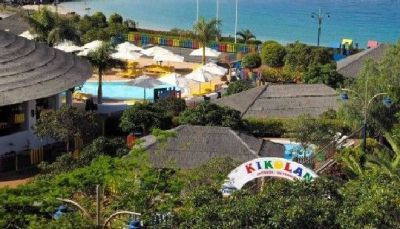
Sports courts, swimming pools, mini golf and private parking lots of hotels and lodging complexes in Playa Blanca "illegally" occupy plots that, in reality, are of public ownership and should be green areas and open to all residents. This has been highlighted in a report carried out by the technicians of the City Council, which, yes, is only "partial", according to themselves, since it focuses on the partial plans of Montaña Roja and Costa Papagayo.
As a result of this report, the plenary of the Yaiza City Council agreed last Thursday to initiate the procedures to recover these public spaces, although the City Council has not provided official information on the matter so far. The agreement of the Governing Board that was taken to the plenary intended to give one month to those affected to free up that land, as well as to initiate files "for the protection of legality and the restoration of the disturbed legal order", given the existence of works that have been carried out on that public land.
In addition, the mayor of Yaiza, Gladys Acuña, also intended to study the possibility of charging taxes to companies and individuals for the occupation of that land. However, regarding that possibility, a report by the City Council's auditor, dated January 12, to which La Voz has had access, flatly rejects it. And he argues that since there is no title that enables them to occupy that land, "there is no way to proceed with these tax settlements." In addition, he emphasizes that, "obviously, there is also no fiscal ordinance collecting a case of fee for illegal occupation of public domain."
"Perverse effect"
In his report, the auditor also warns that establishing the collection of taxes "could have a perverse effect of providing legal coverage to occupations that in principle lack an enabling title." In fact, he adds that since it is not only about occupations of public land, but also of green areas, there are "real criminal indications against land management". Therefore, he understands that "it must be elucidated in the corresponding urban planning sanctioning procedures and for the restoration of the altered urban planning legality."
The facts, according to what the secretary of the City Council, Vicente Bartolomé Fuentes, points out in one of the certifications, were highlighted in a plenary session held on November 3, 2011. The next day, the mayor ordered the municipal technicians to prepare a report. The report was delivered 20 days later, on November 24, 2011, although so far only with information from two of the partial plans of Playa Blanca, at least that has transpired or has been taken to the plenary.
Costa Papagayo
Regarding the Costa Papagayo Partial Plan, the technicians emphasize in their report that, in their day, when granting the licenses for the first occupation of some buildings, the Technical Office already reported that green areas were being occupied. They even point out that they even prepared another specific technical report on the matter. Now, in this new report they cite eight cases of occupation of public land in Costa Papagayo:
Hotel Princesa Yaiza: Occupies a public green area with Kikoland, a private children's leisure space, where there are also tennis courts, swimming pools and a restaurant.
Hotel Embajador: Occupies a public green area with two tennis courts and some warehouses that are fenced. Although in other cases they do not provide dates, in this one the technicians point out in their report that the municipal building permit is from 1989.
Hotel Playa Dorada: Occupies a public green area with a mini golf and a cafeteria.
Sun Tropical and Sun Royal complexes: They have occupied the green areas adjacent to tents, swimming pools and recreational areas.
El Aulagar Residential: Occupies a public green area with a parking area and a perimeter wall.
Homes on the western boundary of La Fragata street: According to the report, the owners have "appropriated" green areas, erecting perimeter walls.
To these five cases we should add another three, of which no data is provided on the companies or individuals. In them, there is talk of occupation of green areas in several streets in the north of this partial plan, as well as in the south of plot "I". In the latter case, where the public green area should be, there is a market "asphalted and with perimeter walls."
Montaña Roja
As for the Montaña Roja Partial Plan, the report points out up to 13 cases of illegal occupation of public land:
Apartotel Paradise Island: Occupies a public green area with two tennis courts, a mini golf and a recreational area for children. La Voz de Lanzarote had already echoed this situation a few months ago. And it is that this hotel, which already occupies public land, asked that more land be ceded to it by the City Council to build a theme park with an aquapark.
Hotel Lanzarote Park: Occupies a public green area with two tennis courts.
Playa Limones Complex: Occupies a public green area with a mini golf.
Famingo Complex: Occupies what should be a public parking area, with a multipurpose sports court, for handball, tennis and other sports.
Lanzasur Club Complex: Occupies part of a public green area with parking for the complex.
Corbeta Complex: Several of its bungalows are occupied on what should be a public road. (since before 1988). Said road has "disappeared".
To these we must add another seven cases in which the person responsible is not identified. In most of them, public land destined for green areas has been occupied (or has been significantly reduced) to build facilities such as a volleyball court or a swimming pool. In another, a public road area is invaded, in Francia street, where some parking spaces occupy part of what should be the road.
In addition, the situation of the plots near the bus station is also particularly striking. Along Gomera street there should be a large public green area but, according to the report, the owners of four plots have made perimeter walls, eating part of that green area. Even the bus station itself, a public building inaugurated a few years ago, also invades part of that green area.


