
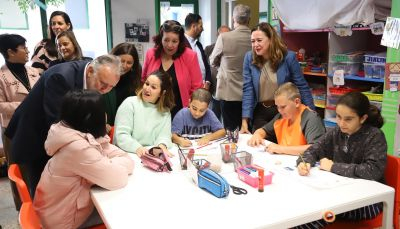
The president of the Cabildo of Lanzarote, María Dolores Corujo, visited the CEIP Concepción Rodríguez Artiles in Puerto del Carmen this Friday morning, where the 0 to 3-year-old classrooms have been inaugurated this year, "taking a further step towards the commitment acquired by the Island Institution and the Government of the Canary Islands with early childhood education based on inclusion and equality," they point out from the Cabildo.
Dolores Corujo was present at the educational center accompanying the president of the Canary Islands, Ángel Víctor Torres, the Minister of Education of the Government of the Canary Islands, Manuela Armas, and the mayor of Tías, José Juan Cruz, among others, being received by its director, Ana Pilar Verdugo.
"For Lanzarote, it is a source of pride to be a part of and to be leading this change of model in education, betting on the inclusion, integration, and free access to a fundamental service for the little ones and their families, especially for those who do not have sufficient resources," Corujo pointed out.
The president indicated that "for our island, it is very important to have a progressive Government in the Canary Islands, since it is very sensitive to the demands and needs of education in Lanzarote and fulfills its promises. The Government presided over by Ángel Víctor Torres committed to betting on a universal, public, and quality education from 0 to 3 years old, and it has done so," she stressed. According to her, "the five schools in Lanzarote with 0 to 3-year-old classrooms will be joined by six more next year, making a total of 11."
The regional president, Ángel Víctor Torres, describes the school as a "model" center and highlights that the commitment to free education from 0 to 3 years old is now "unstoppable" due to the "commitment of the autonomous Government to equal opportunities and public services."
In the same act, the Minister of Education, Universities, Culture and Sports, Manuela Armas, thanked the president of the Canary Islands for his "sensitivity and interest" in "the work that is carried out in the centers and the support given to the schooling process from 0 to 3 years old, in pilot mode in 34 classrooms on the islands and with 40 more planned for the 2023-24 academic year."
Finally, Torres also emphasized that 60% of the students in this center are from other countries, "so they grow in solidarity and coexistence, and this enriches the Canary Islands and makes us stronger. There are boys and girls who have come from Nepal, Bangladesh, Africa, Europe, North and South America, with teachers who teach them languages. This is essential in the education of the Canary Islands; it makes us unique and makes us a much more inclusive, integrated, and integrating Community."


