
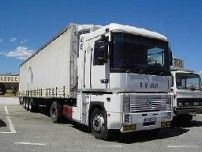
The Federation of Transport Businessmen of the Canary Islands (FET) has contacted both the concessionary ITV stations, as well as the General Directorate of Industry, expressing its "surprise" and "outrage" with the new method of checking braking systems, which is included in the new manual prepared by the Ministry of Industry.
According to FET, until now the tests were carried out with the vehicle empty. However, from this year 2012, the vehicles must be loaded. "That trucks must be loaded with merchandise that belongs to customers or buses must be loaded with passengers when passing the ITV, is manifestly impossible to comply with", FET states.
And the calculation formula, they explain, is now based on the maximum authorized mass, so the rollers will be calibrated to check the braking capacity of the vehicles with their maximum permissible load. "This will probably result in a vehicle passing the ITV empty obtaining a rejection in the braking system, since it does not exert enough pressure on the rollers due to the lack of load weight."
For this reason, according to FET, the concessionary ITV stations are recommending that carriers, when going to pass the ITV inspection, do so with the vehicle loaded to avoid it being rejected for a very serious defect.
According to FET, the procedure manual states that this measure began to be applied from January 23 for vehicles transporting goods or passengers from 3.5 to 5 tons of maximum authorized mass, and from July 1 it will begin to be applied to those with a higher load.
FET and the Lanzarote Transport Cooperative, Lanztransport, will carry out the steps aimed at correcting "these unthinkable dysfunctions", in order to correct the rule, as the ITV concessionary companies throughout Spain are already doing.


