
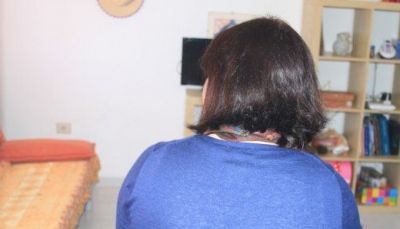
"I am unemployed, divorced, with two children in my care and, to make matters worse, disabled." This is the situation of Carmen, a 46-year-old woman from Malaga who almost four years ago thought she had "won the lottery" when she got a position through competitive examination to work as an orderly in Lanzarote. She took her exam, along with hundreds of people, in June 2010. Since then, she has been waiting to take possession of a position that is already hers. Like her, in Lanzarote, another 39 orderlies are waiting "desperately" to join their positions and nearly 1,000 more people to enter the job pool lists, in the orderly reserve of the Canary Islands Health Service.
Despite the fact that the Basic Statute of Public Employees establishes that the competitive examination positions must be resolved in a maximum of 3 years, the candidates still do not know four years after their exam when they will join their positions. For Carmen, given the wait and the "desperate uncertainty", that lottery "has become a nightmare".
Despite the difficulty of her situation, Carmen does not lose her smile or her Andalusian charm when recounting what she is going through. This pattern maker, converted into an orderly, learned that the position was hers on January 14, 2014. Since she knew that she was already permanent, "with the joy that this implies", she confesses, "every day, every day, every day, at 7:30 in the morning" she enters to consult the website of the Canary Islands Health Service in search of news. "But a month passes, and another month, and another... and nothing. This is already outrageous," she laments.
Until August 2014, Carmen and her two children, a 14-year-old boy and a 6-year-old girl, lived in Torrevieja (Alicante). The Minister of Health of the Government of the Canary Islands, Brígida Mendoza, then said "that she was going to release the positions before the end of 2014" and Carmen had "nervousness in her body". "What do I do? Do I change my children's school in the middle of the year?" she wondered. At the end of that month, after many doubts, she decided to move to Lanzarote, "with all the mess and expense that this entails", but with the certainty that she would soon start working. "But October arrives and no news is seen, November and nothing, we have finished 2014 and we are still without news", she laments.
After having been self-employed for more than a decade and having been successful in her sewing business, she saw how with the arrival of the crisis the profits of her company decreased and she was left "almost ruined". But, as she herself says, she does not rest on her laurels. "I started studying the orderly course in Valencia, I got the title with a 9 and something and, as sewing was not enough, because I also did odd jobs to get by, I decided to take the competitive examination", she explains. And she passed it, "with a good grade", and now she is entitled to a position for disability, since she has a disability of 35% due to a problem in the tendons of her right arm.
She supports her family with just 1,000 euros a month
After closing her company, Carmen had another job in Torrevieja, but that job was only for a few months and ended in mid-2011. Since then, she has been unemployed and, while waiting day after day, she and her two children live "on just 1,000 euros a month". "I am receiving a non-contributory payment and child support, but that is around 1,000 euros a month. A thousand euros to support my two children, and pay for water, and pay for electricity, and food, pay for rent, if they ask for something from schools... It's not enough", she says.
Carmen says that her family helps her and lends her some money from time to time "to pay for electricity, bills, but this is no way to live", she admits. "I would like something better for my children", she says, while asking herself "and when will my turn come? When will I get my position? I have my position, which would be my economic future, that of my children. It is not life to be constantly with the uncertainty of whether I will work or not next month. My children have to eat every month and have a home", she says.
Her non-contributory payment, which she receives "for being disabled, divorced and with two children in her care", is 426 euros per month and lasts 11 months. "It is renewable 3 times and I am already on the second. I can still renew it again, but... what if this is delayed another year?", Carmen wonders.
The taking of possession is eternalized
And that is precisely her fear. "This seems to have no end, that is my fear. My children finish school in June, what do I do, wait all summer, do I enroll them here again without any prospect of taking my position in 2015 either? Because that is what I fear...", she says.
From the unions, they share the same concern. The general secretary of the Federation of Health Workers of the Workers' Commissions in the Canary Islands, José Alonso, is the one who is handling the matter in the union. "Everything is an elephantine thing, very slow, with a lot of delay, because at the bottom of all this is the lack of personnel", he says.
The representative of CC.OO. explains that the positions of orderlies, like the one that corresponds to Carmen, are part of a Public Employment Offer that began in 2007 and in which 96 job categories were included. "We are in 2015 and there are still 42 categories to be resolved", he says. Orderlies, administrative assistants, nurses, nursing assistants... José lists the categories and emphasizes that this translates into "tens of thousands of resources that must be looked at one by one and then answered". "That is done by the technicians, those who do the hidden work. There are only 5 people. That is impossible", he says.
Alonso assures that CC.OO. has "insisted ad nauseam" since 2009 on the need to hire more personnel to speed up the processes. The union has even decided to start a signature campaign on the network, in which the emails are directly addressed to the email of the Minister of Health, so that she can "truly gauge the outrage that exists among the affected people".
Legal breach
According to the Basic Statute of Public Employees, the competitive examinations must be resolved within a maximum period of 3 years. Since that date expired for the orderlies, more than a year ago, "patrimonial responsibility of the administration is accumulating", explains Alonso. In other words, those interested have "the right to return of the expenses unduly incurred and profits that have not been received, one of them is the salary that they should have received since the legal term has passed", he assures.
Carmen, for her part, has no doubt that she will claim what corresponds to her, because she has had to spend her savings little by little when moving with her family to the island. She emphasizes that she came to Lanzarote for the good of her children and because "she believed that she was going to have economic stability" with a job whose start seemed imminent. She smiles kindly while telling it, but she is forceful. "They are touching the economy of my children, and that cannot be allowed", she warns. Carmen concludes with a reminder for the administration: "we do not come to live off the story, we come to work".


