
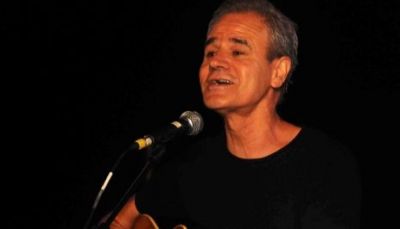
They have been on stage for more than 30 years claiming the Canarian identity and, as their singer, Luis Morera, explains, remaining "faithful" to their ideas. The palmero group Taburiente will close the San Ginés festivities, with a concert that will take place next Thursday, August 25, at 9:00 p.m., on El Reducto beach. An event in which mythical songs such as "Ach Guañac" or "La Alpispa" will not be missing, which have already become a symbol of this group.
What does it mean for you to perform in Lanzarote and, more specifically, at the San Ginés festivities?
We are a group that since we were born we have had the vocation of expanding throughout the seven islands and I cannot tell you that it is more special than others, but we do have an approach to Lanzarote for the entire time we lived with César Manrique, in his house, we saw him when we went to perform. That time was beautiful and then I also spent my time in Lanzarote. It is a very close island.
And how would you define the conejero public?
I was recently at the Mar en Calma Festival and there was such a welcoming silence that it was charming. All I can tell you is that it is a sensitive and supportive audience. The culture that César left there has been forging over time and it shows in Lanzarote. It is an island that can boast of liking culture and of being one of the most cutting-edge.
What kind of show are you going to offer in San Ginés?
The Taburiente that has never been diluted, the Taburiente that continues with all the experience fusing from its beginnings and, above all, mixing its repertoire of new songs with the old ones. The public always asks for emblematic themes, which have marked special moments for them. When they listen to them, it takes them through the tunnel of time. Music has that power.
What are the songs that the public always demands?
We have a few songs in which we connect with the public, which they sing and which are also very beautiful. There are songs like "Ach Guañac", "La Caldera" or "La Alpispa", which people sing and raise their hands. They are very exciting moments. We are a group that over time has penetrated the public, because we have remained faithful to our ideas for a long time, claiming, but above all with joy and love for our land.
You speak precisely of claims, but in the more than 30 years of history of the group those ideas will have changed. How have they evolved?
It seems that the human being in the background repeats the same canons of attitude, because I can say that themes that we created more than 20 years ago are very valid today. We creators are always a bit visionary, we are ahead of the times. For example, what is happening now with the "outraged". I was an "outraged" at that time, when the dictatorship was in place and I am still outraged. And it is a joy to see the new generations now, who protest and say the things they need. I remember a song, "Generación 2000", which speaks precisely of what is happening today. And our music is still valid, because we continue to be spokespersons for social ideas, for what happens to both adults and young people.
And in terms of sound, how has Taburiente evolved?
There is one thing that is clear and that is that in maturity your ideas are settling and you understand music much more and you find more ways to express yourself. And today we have the wisdom and when creating we have things very clear, especially the poetic part.
Has the fact of defending the Canarian identity in your songs ever prevented you from being successful outside the Islands?
That is why we decided to live in the Canary Islands, because it made no sense for us to continue claiming a feeling of identity outside the Islands. We are called to the global, but the sad thing about the world is that it loses its diversity and that everything is mixed into one and we all end up being Chinese, Americans, etc. Welcome be an old man from Fuerteventura singing as he sings, saying here is the identity.
How do you remember the beginnings of Taburiente?
The whole beginning was in a difficult time in Barcelona, Madrid... A time of dictatorship, of searching for freedom. All of Spain was in total convulsion, with characters like Luis Llac, Raymond, Labordeta, Víctor Manuel? Naming them all would be endless. It was an exciting time, because the generations were alive, they were beginning to fight for ideals, as is beginning to happen now. It was hard and exciting. With time we came to the Canary Islands and decided that the homeland was made within the homeland itself. Some say that we did wrong because we could have expanded to Europe, but our ambition was more cultural and closer to the land.
At what point do you think Canarian popular music is?
I think it is in a moment of boom, because it is sheltered, very supplied and sometimes even oversized in groups of revelers. I think it's great, because until very recently I was complaining that Latin American music was getting too much and changing our customs. And yet the new generations enjoy the parties, with the timple. It has been an enriching stage and the Canarian continues to claim his music. What I do complain about is that creative, fusion music is at a minimum. That is the one that is not supported.
What is the future of Taburiente?
We would like, and I personally, to grow old on stage, to be helped up the stairs, and sit there with all the experience and see a full auditorium, that they come to listen to us for having maintained our identity and enthusiasm. That's why the kids see us and call us. You see, I'm already 64 years old. But that means we are on the right track.


