
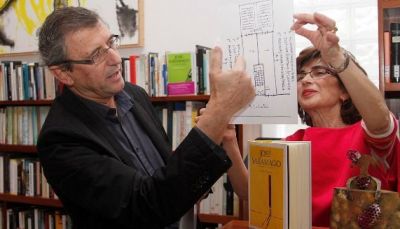
'Claraboya' is a novel that José Saramago finished writing in January 1953 and was never published. In 1988, a Portuguese publisher found the manuscript but Saramago did not want it to be published while he was alive. Now Alfagura has just published it, with a prologue and translation by Pilar del Río, and this Saturday it was presented in 'A casa', the writer's house in Tías (Lanzarote), coinciding with the first anniversary of the opening to the public of the writer's house museum.
The presentation was given by Fernando Gómez Aguilera, director of the César Manrique Foundation and biographer of the Portuguese writer. "No one knows Saramago as well as Fernando," said Pilar del Río, president of the José Saramago Foundation, who closed the event in the library of the Portuguese Nobel Prize winner.
Gómez Aguilera said about this book that although it is the first one presented without the author being present, "the author is all there" and that it is a book of misfortunes written in an era in which "a young man seeks his destiny and does not find it." Saramago stopped writing after this novel and did not publish another until 1977.
According to Gómez Aguilera, "this novel deserves to be read today because it has connections with the current world" and deals with boredom, cowardice, destroyed lives, lack of love, couple relationships or lack of respect, in addition to constituting "a great literary testimony about the Portuguese writer because he is at the center of a disappeared period of José ".
He said that "the lack of fortune of this novel expels Saramago from literature" and recalled that other books by great writers were rejected by publishers, such as 'One Hundred Years of Solitude', 'In Search of Lost Time', 'Harry Potter', 'Dubliners' (rejected by 22 publishers), 'Lolita', by Nabokov, 'Games of Late Age', by Luis Landero. "Talent - according to Gómez Aguilera - is not always recognized by life, but it is never too late to turn adversity around."
He assured that in this book there is a reflection on evil because Saramago was concerned with giving life a meaning and that the only antidote that the writer offers as a possibility of redemption is love. He also said that the novel was difficult to publish in those years and that it was probably not understood.
DEL RÍO
For her part, Pilar de Río said that what bothered Saramago the most when he sent the novel to the publishers was that they did not answer him and he did not feel respected. After its discovery in 1988, the writer said that he did not want to see that book published in life "but he did not say - Del Río clarified - that he did not want it not to be published. "He would like to have a new book when you are already dead." "It is a gift that he has given us," he said.
The president of the Saramago Foundation referred to the first anniversary of the opening of the writer's house museum and said that the objectives have not been met in terms of the number of visitors or the economic ones for the survival of the house, but it is still open and "even if only one person comes, there will be someone accompanying them on the visit because we have decided to treat people with respect and give them coffee", he concluded.
SG-ACN


