
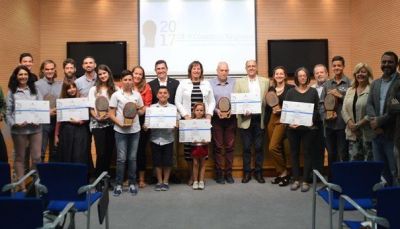
The Government of the Canary Islands presented this Wednesday the awards of the second regional competition 'Heritage Education Initiatives', an award that recognizes didactic projects aimed at promoting and valuing the heritage of the Canary Islands in the classrooms and that this year has fallen on nine centers, among which is the CEIP Alcalde Rafael Cedrés de Tías.
These awards, promoted by the Ministry of Education and Universities of the Government of the Canary Islands from the 'enSeñas' program of Canarian contents, and by the General Directorate of Cultural Heritage of the Ministry of Tourism, Culture and Sports of the regional executive, seek to promote work on heritage in a transversal way, rewarding initiatives that address the subject from a cultural and historical perspective, as well as natural, social or artistic.
Thus, in the 2017/2018 edition of the contest, the Centers of Early Childhood and Primary Education (CEIP) Alcalde Rafael Cedrés (Lanzarote), Breña (La Palma) and Puerto del Rosario (Fuerteventura) have received the award; the Secondary Education Institutes (IES) Siete Palmas (Gran Canaria), Punta Larga (Tenerife), Ichasagua (Tenerife) and Puerto del Rosario (Fuerteventura); the Adult Education Center Guayafanta (La Palma); and the School of Art and Higher Design of Gran Canaria.
A project based on the stories and experiences of the elderly
The initiatives awarded this year address the heritage of the Canary Islands from a wide variety of perspectives: historical heritage and heritage elements close to the center, traditional clothing and legends of the Islands, trails and natural resources, research on the gastronomic heritage of the Canary Islands, art and culture, as well as a photographic look at the Canarian natural landscape.
The research project of the CEIP Alcalde Rafael Cedrés de Tías and awarded in this edition is titled 'The knowledge of a people' and is based on the stories and experiences of the elderly, so that it combines learning-service with research by the students themselves.
The project of the Lanzarote center arose from the curiosity of the student Diego Espinaza, who told the director of the center that his grandmother had worked in the Salinas de Janubio, giving rise to the idea that structured the didactic initiative.
Work in the defense of the heritage of the Canary Islands
The Minister of Education and Universities of the Government of the Canary Islands, Soledad Monzón, participated in the presentation of the awards, an event that took place at the headquarters of her department in Tenerife and in which also participated the general director of Cultural Heritage of the Ministry of Tourism, Culture and Sports, Miguel Ángel Clavijo, and the director of the Canarian Agency for University Quality and Educational Evaluation and the Innovation Service of the Ministry of Education, Teresa Acosta.
"The work that has been carried out, day by day, in the classrooms by the teachers and students participating in the projects that we recognize today, deepening our history, our customs, our heritage, is an example that we can feel Canarian 365 days a year and not only when we celebrate our Canary Islands Day", said the head of Education, Soledad Monzón, who stressed that this is the line of work that is developed from the program 'enSeñas' of Canarian contents.
In addition, the regional Minister of Education conveyed to the teachers that the recognition of their work will not be reduced to the delivery of the awards: "There are great works that can be editable and worthy of transferring to other educational centers", said Soledad Monzón, who encouraged the participants to continue working in the defense of the heritage of the Canary Islands since, she said, "only what is known and cared for is what remains".
For his part, the general director of Cultural Heritage, Miguel Ángel Clavijo, indicated that "the first trench to defend the Canarian heritage rests in Education, hence the importance of the coordinated work between the different areas of the Government of the Canary Islands to articulate an initiative that, although it has two years of life, has a great expectation for young people to be able to deepen their culture and identity". "Heritage education is capable of structuring the coexistence of the current Canarian population", he stressed.
Finally, the director of the ACCUEE, Teresa Acosta, explained that "this year it has been possible to increase the number of awards, delivering three for each of the three existing modalities" and pointed out that, in this way, the call is extended allowing "to recognize and value all the work that is being done for the knowledge and dissemination of heritage, from all its perspectives, throughout the Archipelago".


