
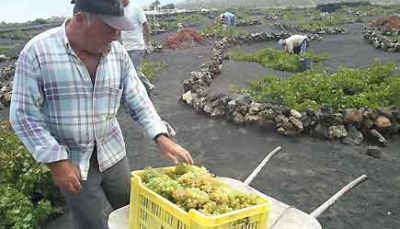
Lanzarote's winegrowers and winemakers are in full swing. Last week, the harvest already began in some parts of the island, especially in the wine regions of San Bartolomé. Farmers from Mozaga, Masdache, Conil, and La Asomada are already harvesting grapes. Earlier today, Bodegas El Grifo started the harvest, leaving instructions, conditions, and prices for this season at the entrance of the facilities.
LA VOZ traveled to the vineyards in the center of the island to witness the beginning of one of the most successful wine campaigns in recent years, both in quantity and quality. However, not all news is positive for the farmers. They see the future of the countryside in Lanzarote increasingly bleak. There are not enough people to work. Despite still complaining about unemployment in the Canary Islands, nobody wants to work in the fields, which, according to the winegrowers, will considerably delay the end of this season's harvest.
The people in the countryside are desperate. In some vineyards near Masdache, four farmers are working late to harvest as many grapes as possible before the wineries close.
The owner of the land, Miguel González de León, is outraged with the winemakers because they apparently made him lose a lot of time in the morning. He was the last to take the boxes to collect the grapes, even though he claims he arrived first. Thus, much precious time was lost. Later, González de León is the last to arrive to deliver the harvest. The farmer's day, which had started at five in the morning, does not end until after half past two in the afternoon. But it is not only the wineries that have the winegrower burned out. There is no labor in the field to harvest the grapes. This man has three employees to harvest his entire crop. He had planned to finish the harvest in a week, but it seems impossible.
"I see this countryside thing as terrible; people don't want to work," González de León said dejectedly.
Additionally, the farmer also had some warm words for the Cabildo of Lanzarote, which, in his opinion, should take care of the surplus grapes. "Why do they start talking about agriculture if they then see you there and turn away from you?"
The same scene is repeated at the doors of El Grifo, where trucks loaded with boxes of grapes await their turn to unload the fruit. At least five station wagons patiently wait to conclude the workday.
And here, LA VOZ spoke with another farmer, Rivera Guerra, one of the oldest and wisest in the area. The man is not only burned out with the lack of labor but especially with Inalsa's rate for water for agricultural use, which this year increased based on the diameter of the pipes for irrigation. But what also angers Rivera is the passivity of most farmers. There will be "about 2,000 farmers in Lanzarote, but only six of us have signed a petition demanding that Inalsa" restore the previous prices. The farmers do not complain because "we are logs, uneducated," the winegrower said desperately, tired of the abuses of the Lanzarote water company and the slowness of his fellow sufferers.
The wineries' estimates
Manuel Díaz Rijo, majority partner of Bodegas Mozaga, which were the first to start the harvest on the island, commented in statements to this newspaper that "the grapes are coming in healthy, which is very important for the quality of the wine to be higher." In this sense, and also considering the excellent climatic conditions in which the grapes have matured this season, it is not surprising that Rijo, like all winemakers and winegrowers, considers that the quality of this year's wine will be unbeatable, although the businessman reminded that it largely depends on the technological process to which the fruit will be subjected for the elaboration of the final product.
Regarding the forecasts of the harvest volume, the estimates differ between farmers and wineries. According to Rijo, this season's production could reach 3 million kilos of grapes, while according to a farmer who answered LA VOZ's questions at the doors of El Grifo, the production would be around 30 percent higher than last year. "It may happen that there is a little surplus of grapes and it happens as in the year 2000," Rijo said, referring to the wineries registered in the Regulatory Council of the Designation of Origin of Lanzarote Wine.
Bodegas Mozaga expects the harvest to end in about two weeks, although the Diego variety, highly appreciated in this company, will not begin to be harvested until the beginning of September because its maturation in the vineyards takes longer.
The price of grapes
As every year, the aspect that most worries the farmers is the price of the grapes. As the winemakers had told this newspaper in recent days, the price has hardly changed compared to last year. This has happened despite the concerns that the winegrowers had days ago, who feared that the alarm of overproduction launched by the Cabildo would cause a decrease in the value of the grapes. But according to the winemakers, the price does not change because the production volume of the wineries hardly changes from one year to another, because after all, each company only buys the grapes it needs according to the marketing forecasts, which by the way are getting worse and worse on the island. "Here, the effect that when there are many grapes the price goes down has never occurred. What can always happen is that there is surplus grapes and we are not able to absorb them, but not due to lack of capacity, but due to lack of market," Rijo said.
Bodegas Mozaga pays 1.5 euros per kilo of white grapes this season, while the kilo of black grapes is paid at 1.65. For its part, Bodegas El Grifo, which started the harvest yesterday, has established prices according to the class of grapes.
El Grifo has changed its strategy this year and has made it a little more difficult for the farmers. At the door of the booth in the company's facilities, instructions for this year's harvest urge farmers to separate the Malvasía variety from the Listán variety at the source. Both are very good, but the former is the most appreciated by the winemakers. Thus, the kilo of Malvasía is paid at 1.5 euros in El Grifo, while the kilo of Listán is taken at 1.35. For its part, mixed white grapes are paid at only 1.20 euros, thus encouraging farmers to separate the grapes when harvesting them.
Excellent quality grapes
This year, everyone agrees on the excellent quality of the grapes. According to the majority shareholder of Bodegas Mozaga, "the quality of the grapes will be excellent," although Rijo reminded that the quality of the wine will depend on the winemakers and the fermentation of the must.
The winter rains allowed the vineyard to grow better and the grapes to be larger, so more must can be obtained from the same. In addition, the crops have not been affected by any pests. The wineries have their own vineyards, but their crops do not fully satisfy their needs, and therefore they buy grapes from independent winegrowers.


