The approval of Royal Decree 666/2023, which regulates the distribution, prescription, dispensing, and use of medications by veterinarians since July 2023 in Spain, has generated criticism throughout the country since its implementation. However, these have intensified since the beginning of this year, when a central communication channel was implemented where veterinarians have to communicate their medication prescriptions.
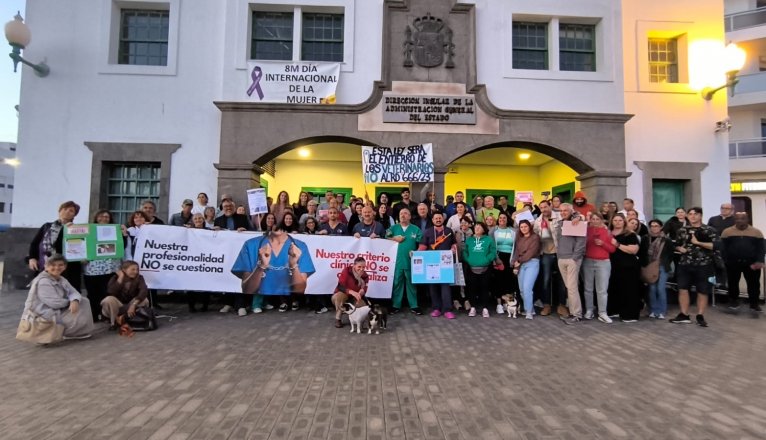
Within the framework of these mobilizations, veterinarians in Las Palmas have delivered 20,500 signatures against the regulation, which they accuse of "limiting and slowing down" their work. Likewise, animal health specialists in Lanzarote have demonstrated in front of the Government Delegation on the island to demand a "fairer" adaptation of the law to the daily reality of clinics.
Veterinarian Nerea Tellería has offered an interview to La Voz to delve into the demands of her sector, where they are asking for the repeal of the controversial decree. Among the most criticized guidelines of the regulation, Tellería points out the imposition of prescribing antibiotics following a scale that starts from the mildest to the strongest medication and that punishes with fines of between 60,000 euros and one million for non-compliance with the regulation. "Whoever made this royal decree did it from an office and did not realize that there are many things that are not applicable to the street," she adds.
In addition, she criticizes that this decree deprives veterinarians of the possibility of directly dispensing medication to pet owners and makes them have to go to pharmacies. "I want to be able to dispense a complete five-day treatment and not have you go to the pharmacy and possibly the smallest box they are going to sell you is 50 or 100 tablets," explains Tellería, who denounces that this change makes pet treatments more expensive.
"According to the Royal Decree, we have to start with the mildest, if it doesn't work, then the next, if it doesn't work, then the next. Which implies money and loss of time and that the animal is not going to get better," adds the professional.
In this sense, she indicates that a new scale of antibiotics must be followed that prevents the use of a higher-level medication if a less strong one has not been tried before and that this measure has already harmed animals in the peninsula. "It's just that now an animal comes to me with an infection and the first thing I start doing is praying, saying 'my god, my god, my god, may it not be serious'," she adds.
Obelesa Hernández, representative of the Sara Animal Shelter, also speaks along these lines, highlighting that it is an "incongruity" on the part of the Government to want to combat resistance to antibiotics, while promoting that animal owners take home more medication than has been prescribed by the specialist. "What it is going to incite is that the owner, when their animal is sick, will self-medicate it, because they have leftover medication," she insists during an interview with this medium.
Among the restrictions that the Government of Spain has established for veterinarians is the impossibility for pets to share medications normally prescribed to humans. "Before, you could go to the pharmacy with your veterinarian's prescription, you bought the human brand, but it's really the same composition, now no. Now it has to be the brand for animals, which although the composition is the same, costs much more," indicates Hernández. At this point, veterinarian Tellería specifies that they demand to be able to use medications for humans in large dogs or in certain cases where there is no veterinary medication, "as we have done until recently."
The island director of the State Administration in Lanzarote, Pedro Viera, tells La Voz that this decree "is part of Spain's adaptation to European regulations on veterinary medicines, in line with the European Union regulation" in order to "improve control and transparency in the distribution of antibiotics. Thus, Viera assures, in line with the Spanish Government's argument, that its creation seeks to fight against the resistance that the population is creating to antibiotics. "It has already been applied in the livestock sector since 2019 with positive results." In response, veterinarians assure that in the Spanish adaptation to the European directive, "Spain has gone too far."
Likewise, from the Sara Animal Shelter, they warn that this royal decree is also more harmful to street animals, which do not usually have a chip. "It is limiting the treatment with antibiotics to only animals that have a chip, and what do we do with all these poor street animals that are on the street? They already have enough suffering on the street, so that on top of that they arrive at our protection in subhuman conditions and we cannot treat them," she adds.
In addition to the increased cost for animal care, veterinarians report the "bureaucratic burden" they carry after its approval. "Every time we prescribe an antibiotic, we have to send it to a national platform," explains Tellería, who questions that there is already "an antibiotic control agency at the national level."
Finally, Viera defends that "the administration is aware of the importance of facilitating the transition of professionals to the new regulatory framework" and that, therefore, "a broad transition period was proposed from June 2023, allowing them to adapt their system."