
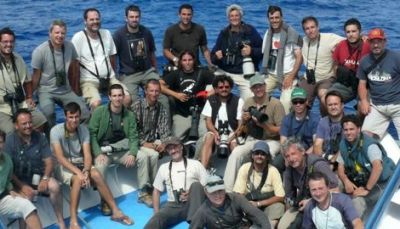
A group of about 25 ornithologists specializing in seabirds, led by Juan Sagardía and Daniel López Velasco, made an expedition on September 10 and 11 to the Banco de la Concepción. A submerged volcano located about 50 miles northeast of Lanzarote that, according to Juan Sagardía, is "a key point in the migratory route" of some seabirds that have rarely or never been seen in Spain.
The idea for this expedition arose after it became known, through the Oceanographic Institute, that the Banco de la Concepción, "is a good place for the sighting of birds and marine vertebrates", due to its "high concentration of organic matter", according to Sagardía. "They work to map the bottom of the Banco de la Concepción. In their campaigns, they always took an ornithologist, but they didn't take any fish to attract the birds and really see what was there," he adds.
And precisely, to discover that mystery, Juan Sagardía and Daniel López Velasco decided to organize an expedition to the Banco de la Concepción. "We have several forums where we talk about birds and Daniel López Velasco, who at 22 years old is the most knowledgeable about birds in Spain, and I posted a message, in order to get people to join," says this ornithologist.
Thus, a total of 25 seabird specialists gathered in Lanzarote and set sail by boat to the Banco de la Concepción in the early morning of September 10, on an expedition that until now "had never been done" and that departed from Órzola.
And the first observations soon appeared, as, on the way to the destination, and already near the Banco de la Concepción, a Black-bellied Storm-Petrel appeared on the starboard side, a bird characteristic of the southern hemisphere that, according to Sagardía, had never been seen in Spain. "It is the first time it has been seen in our country, the second for the Western Palearctic region (geographical region that covers the whole of Europe, western Asia and North Africa) and the sixth for the northern hemisphere," he explains.
Surprised by what they saw, Sagardía says, they decided to stop the boat in the hope of seeing this specimen again, although it was "in vain", as the bird did not reappear. However, the blocks of frozen fish thrown into the sea in order to attract the birds had their effect. "They are thrown into the sea and as they gradually melt, the birds go to eat. They detect the smell," explains this ornithologist. Thus, after an hour of waiting, the crew saw numerous seabirds appear before their eyes, including specimens of Wilson's Storm-Petrel and Pomarine Skua. Two species considered "as rarities for Spain" and that "is the first time they were observed in Lanzarote". "And I think also in the Canary Islands," adds Sagardía.
But these seabirds were not the only ones seen by this team of ornithologists. And it is that, among the specimens that they were able to observe and photograph in the two days of expedition, was also the Long-tailed Jaeger. Another bird that, according to Juan Sagardía, is also the first time that it is observed in Spain and the second in the Western Palearctic. "They are also birds from the southern hemisphere, which are going to spend the summer in Newfoundland, in Canada, and on their journey they pass through the waters of the Canary Islands. We were aware of its existence, because there were birds that had been fitted with GPS and it showed that on their migratory journeys they passed through there, but they had never been seen," he explains.
Other birds that could be seen during the expedition were the Pomarine Skua, the Arctic Tern, the Black Tern and the Red-necked Phalarope. Specimens of White-faced Storm-Petrel and Madeiran Storm-Petrel were also seen, "both breeding in the Canary Islands but very difficult to see", according to Sagardía.
Record of the birds
The other organizer of the expedition, Daniel López Velasco, together with other members of the excursion, are members of the Rarities Committee. This is a working group of the Spanish Ornithological Society SEO/Birdlife, which was created in 1984, and which is responsible for collecting, approving and publishing the observations in Spanish territory of the species and subspecies included in the List of Rare Birds of Spain. "They are responsible for certifying that that bird is the one you say it is and not another," he explains.
Thus, these birds that have now been observed in the Banco de la Concepción will be recorded in the Report of Observations of Rare Birds in Spain, which SEO/Bird Life publishes annually.
Juan Sagardía's explanation of why these birds are in the Banco de la Concepción is because, in his opinion, it is "a key point in their migratory route". And, he adds: "I think that if they have not been seen before it is only due to lack of observation, exclusively".
On their trip, in addition, the crew crossed paths with several cetaceans, fish and turtles such as sperm whales, several species of dolphins, flying fish, sunfish, loggerhead turtle and even a hammerhead shark, among others.
RELATED NEWS
[The island suffers "a degradation of habitats for birds"->60430]


