
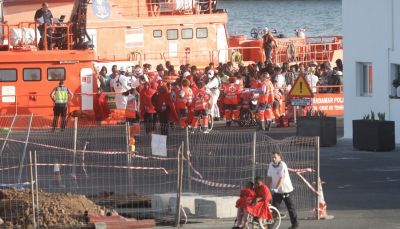
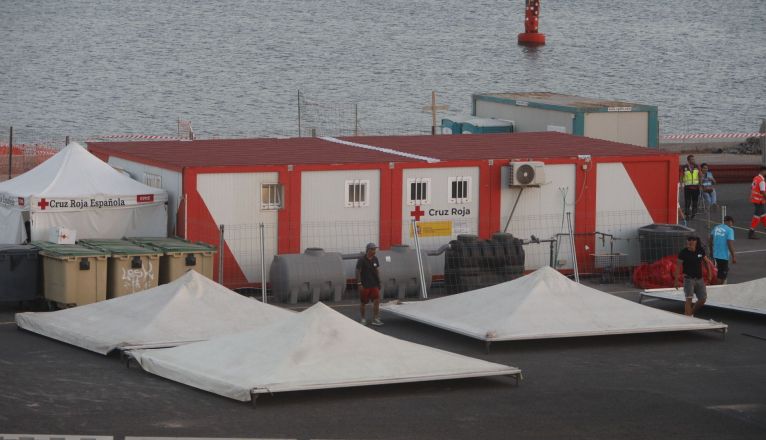
A total of 95 migrants were forced to sleep on the floor in Lanzarote due to the lack of permanent resources. Upon arrival in Puerto Naos, the members of the last two boats rescued this past Monday were housed in tents at the foot of the port.
Of the 98 assisted in the last two precarious boats that arrived on the island on the afternoon of this Monday, initially estimated at 120 people, three were transferred to the hospital for various pathologies. The rest spent the night in plastic tents under the custody of the National Police after being attended by Red Cross volunteers.
The manager of the Security and Emergency Consortium of Lanzarote, Enrique Espinosa, assures in statements to Radio Lanzarote-Onda Cero that everything possible was done so that people "did not sleep outdoors" and the space was adapted with "everything necessary" so that they could spend the night there.
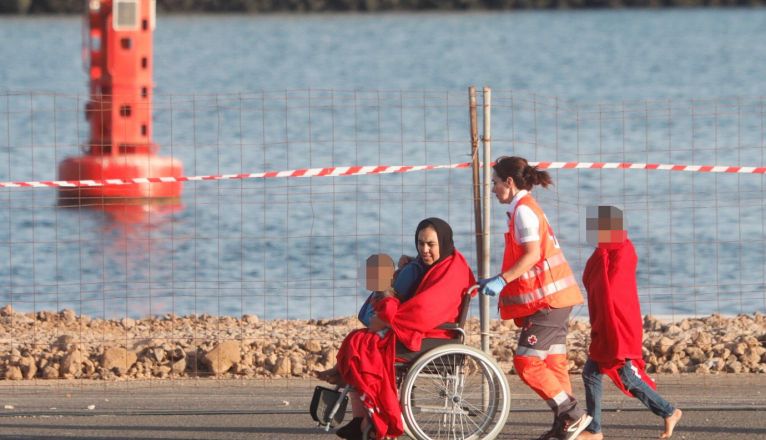
Meanwhile, the space in which they were to be attended, the Temporary Foreigner Reception Center (CATE) of Arrecife, was at the limit of its capacity. Specifically, with the rescues of six precarious boats between Sunday night and Monday afternoon, it reached 270 people. At that moment, the Ministry of the Interior decided to reduce its capacity to avoid risks and seek a temporary alternative.
At 9:30 a.m. this Tuesday, the tents continued to house migrants inside at the foot of the Puerto Naos dock. At the door, agents of the National Police guarded the place. It should be remembered that the first 72 hours are affiliated and their data is collected, as well as the first interviews are carried out.
In addition, one of the boats that were rescued on the afternoon of this past Monday, near Roque del Este, had been requesting help since the morning. For this reason, they presented more symptoms of dehydration when they were rescued. However, they also slept in the port.
The Councilor for Social Welfare of the Cabildo of Lanzarote, Marci Acuña, has also intervened before the radio microphones to add that "tents, mattresses and sanitary bathrooms were enabled. Within the improvisation and the urgent situation, an attempt was made to make them as comfortable as possible." In this way, the Cabildo responded to the request for collaboration from the National Police.
Regarding the arrivals between Sunday and Monday, Acuña explains that "many families and many children" have arrived at the temporary reception center for migrant minors in La Santa. "Especially in sub-Saharans, the situation of entire families coming is common, while Maghrebians tend not to come accompanied," he explains.
In principle, 18 unaccompanied minors were incorporated. The center of La Santa currently houses around 60 minors. This is what Acuña anticipates. "Our capacity is 80, although it may be able to accommodate more, but our approach is for it to be at 40 and not exceed that," he says. Regarding dismantling the La Santa center, as requested by the mayor of Tinajo, Jesús Machín, the councilor assures that "it is on his agenda, but one thing is what is important and another is what is urgent. Now the urgent thing is to attend to the people who arrive one day and another, which prevents that objective from being satisfied in a short space of time."
To this must be added the rest who arrived on the coast with their families. In this case, they are referred to the Montaña Mina center in Argana.


