
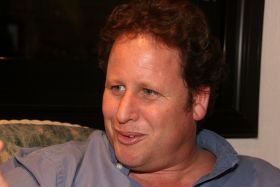
At the age of 10 he was taken to the Sahara. At 43, he has already traveled the world, shooting documentaries on routes lasting more than a year. "I had no house, or anything, just an account number." He was in charge of opening the "Cinema and Migration" cycle, held in Arrecife, at the initiative of the Canary Islands Foundation for Social Development). Three sessions and three debates: the journey, the causes and racism. With "14 kilometers", winner of the Golden Spike last year, the reflection began. The dead that the Tuareg bury in the desert were the seed of the project. Two months of filming, in which Olivares contracted malaria, hepatitis and a tick bite that introduced a virus, captured a shocking truth, as common as it is unknown. A handful of sand in the eyes, Westerners, with a clear objective: "To raise awareness among the kids who see a black person on the street and want to punch him".
14 kilometers", is the distance of the Strait of Gibraltar, from the Moroccan coast to the Spanish coast. How did this idea come about?
I took a trip to the Ténéré desert, to shoot a documentary about the salt caravans in northern Niger and I joined a caravan of Tuareg nomads for forty days crossing the desert. We came across two trucks full of people who were heading to the northern coasts, the Tuareg told me that they were sub-Saharans who wanted to enter Europe clandestinely. They told me that when they cross the desert they find dead sub-Saharans, especially in summer, because they travel at night because of the heat, they fall asleep, fall off the truck and die of thirst. They have found 200 dead people around a truck that had been lost in a sandstorm.
Did you want to show all that?
The news director of Telecinco told me that when they broadcast a news item about cayucos, the audience curve drops. And the journey is not just crossing the sea. I wanted to show what we don't see in the media. The other journey that lasts years, where the Algerian soldiers screw them, beat them and rape the girls. They say that as many people die in the Ténéré as crossing the Atlantic. There are more sub-Saharans living in North Africa waiting to cross than in Europe. It seems that we are suffering an invasion and yet they only represent two percent of the immigration that arrives in Spain each year.
The cycle also addresses the causes of immigration.
Basically they do it because of poverty. Most of these people live in countries where there is brutal oppression. They don't have a clear horizon, they don't see a future. In addition, the people who have left and are doing well create legends that push other people to try. Maybe that guy who sends a photo with a car to his family is having a hard time here, but those legends are being created.
And television, what role does it play?
Television has a significant part of the blame for the migratory movements that are taking place in the world. But, the image they have of Europe is not real. They watch series that we watch here, like Friends and Melrouse Place, and you know that life is not like that. But they think that we are all handsome, rich and that we don't lift a finger. An African once told me that we lived well because we had ATMs that gave money on the street. When they arrive, paradise falls and the second drama begins.
For example, they encounter problems such as racism, another of the topics addressed in this cycle.
There is a lot, when the actors came to the premiere of the film in Madrid, you see looks and gestures especially towards black people. I can show you photos of people from the Canary Islands arriving on the coasts of Venezuela in the forties that are cayucos with 200 guys going there. The grandchildren of those people from the Canary Islands are the ones who now see a black person and can't stand him. I'm amazed.
Is it usually people who have not left their place of origin?
I assure you that the guy who has traveled through Africa is very clear about it.
This film serves a bit to bring what they are not going to see.
Of course. I'm breaking my back to get young people to see this film, because they're not going to pay seven euros to see a film about black people. That's why, what I'm trying to do with the Junta de Madrid and Andalusia and if possible in the Canary Islands, is to buy a number of tickets to distribute in institutes and schools, as a school activity, because that seems more effective to me. I've checked it. The kids tell me that when they see a black person on the street, they're going to look at him with different eyes and for me that's the meaning of the film.
So, do you see these cycles as extremely necessary?
Yes, but what happens is that the people who come to this type of initiative are sensitized. And what I want is to sensitize those who are not. I want the guy who sees a black person on the street and wants to punch him to see the film.
You have traveled all over the world, what is the place that has surprised you the most?
A place that touched me was Mongolia. What happens to me with this country is what happens to me with the desert. I have a special attraction. I don't know if it's because of that immensity of lifeless space, that makes you feel small. Nomadic people are pure people, very real people, who are not contaminated and smile at you for real. There are some mountains in Mongolia, the Altai mountains, where a tribe lives that are amazing guys who hunt with golden eagles.
And what have you learned?
Basically to be tolerant, to be humble and above all to put problems into perspective. Here we create mental stories that are too much. That leaves you with a residue, which makes you, perhaps in my case, able to make this film and that people when they see it, get excited.


