
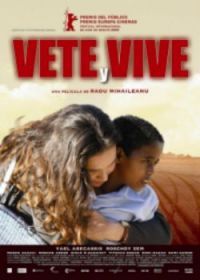
Mihaileanu's film places us in the year 1984. Thousands of African refugees from twenty-six countries arrive at the camps in Sudan. At the request of the United States and Israel, a vast project (Operation Moses) has been launched to bring Ethiopian Jews (Falashas) to Israel. A Christian mother convinces her nine-year-old son to say he is Jewish in order to save him from famine and certain death.
The boy arrives in the Promised Land. Officially he is an orphan and is adopted by a French Sephardic family based in Tel Aviv. He grows up fearing that his secret will be discovered, he is not Jewish or an orphan, he is just black. He will discover love, Western culture and Judaism on the one hand, and racism and war in the Occupied Territories on the other. He will become Jewish, Israeli, French and Tunisian, a true human Tower of Babel. But he will never forget his real mother, the one who stayed in the camp, and he will always dream of finding her again.
The director has managed with "Go and Live" to tell us an authentic epic based on the reciprocal love that a mother and her son have for each other, separated by circumstances but intimately united by another deeper and ineffable reality. But it is also a call for tolerance from the injustice committed against the Ethiopians, sometimes not accepted among their Jewish co-religionists because of the color of their skin or their Christian status, and other times, despised by the international community due to their poverty and lack of socio-economic interest.
The attractiveness of the story is enough to captivate the viewer, an interest that increases thanks to a vigorous start, full of realism and emotion: in the first scene we witness the pain of a mother who loses her son in her arms, to another who heroically renounces hers, and we contemplate characters with an exemplary sense of solidarity. And all this with beautiful photography and images of great visual force, which serve to make the viewer decide to accompany young Schlomo along the difficult paths that await him. Emotional scenes are mixed with other dramatic ones, to give relief to a life of uprooting but sustained by hope, that of someone who struggles not to forget his origin but who also does not want to give up the possibilities that open up to him.


