
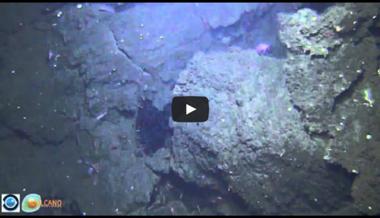
Thanks to the Vulcano project, led by the Spanish Institute of Oceanography, it has been possible to film, for the first time, the underwater volcano of the island of El Hierro from its base to the summit. The images were captured in the second research campaign of this project, which took place last November.
The objective is to characterize the spatio-temporal variability of the physical-chemical, geological and biological properties of the entire periphery of the island of El Hierro from the surface to the first 2000 meters of the water column.
During this campaign, aboard the oceanographic vessel Ángeles Alvariño and thanks to a towed underwater vehicle, equipped with high-definition cameras, the volcano has been filmed and it has been verified that, two years after the eruption, "life begins to flourish".
The video, minute by minute
The first images observed in the video correspond to the deepest area, furthest from the eruption. Large quantities of very fine volcanic material have accumulated here, mainly ash (particles of less than 2 mm) and lapilli (fragments of between 2 and 64 mm). On the more stable substrate, in this area we find sessile organisms (which live attached to the substrate) such as gorgonians, corals and sponges. These species have a very slow growth and, therefore, cannot be new colonizers, but are survivors of the eruption.
As you ascend the slope of the volcano, you find different morphologies. The instability of the volcanic material, together with the steep slope, have caused large landslides and as you ascend the landscape, abrupt areas alternate, where large fragments accumulate, called volcanic bombs, with areas devastated by landslides, in which fine materials predominate.
The cliff areas and accumulation of large fragments are preferred by a multitude of decapod crustaceans and different species of fish, which find a perfect refuge in the new materials.
Observing the rocks in detail, it is possible to observe their first colonizers, mainly bivalve molluscs and polychaetes (a type of annelid with an appearance similar to worms), which attach themselves to the substrate and feed by filtering the water that the volcano has loaded with nutrients.
Near the main cone, the influence of chemical emissions –which still persist– becomes more evident, showing a very colorful background.


