
Lanzarote, together with Fuerteventura, is one of the most desert-like islands in the Canary archipelago and where getting water has always been a real challenge. On average, rainfall on the island barely reaches 200 liters per square meter per year, falling mainly in the autumn and winter months.
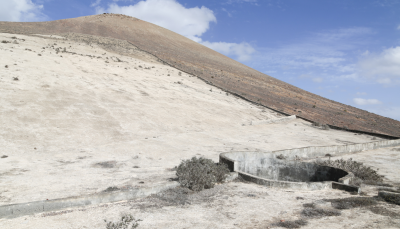
Due to these drought conditions, the people of Lanzarote had to devise ways to collect and store rainwater in the most effective way possible. For this reason, the alcogidas arose, constructions that were established on the slopes of mountains or areas with a steep slope so that rainwater would slide more easily.
Right at the end of the slope was a huge cistern to store all that water and thus be able to dedicate it to agriculture, livestock and human consumption in an era where there were no pipes, desalination plants or any other form of supply.
With the arrival of the first desalination plant in Lanzarote in 1964, the use of the alcogidas began to be abandoned almost immediately. Thanks to the construction of desalination plants, the lives of the people of Lanzarote improved with regard to water, as it ensured supply and convenient distribution.
Different uses of the eras
As for the eras, they were used for other purposes such as cereal threshing. Because the cultivation of products such as barley, millet or wheat was very important on the island, these spaces were used to thresh these cereals, that is, to separate the husk from the grain.
This threshing was normally done with the help of camels, one of the animals that has been historically linked to Lanzarote and whose help was vital in different tasks such as transport, loading or agriculture.
Another of the uses attributed to these spaces was that of dance floor. Nowadays we have squares and stages that are set up during the festivities, but in the old days, the villages did not have these facilities and the eras were the perfect surface to dance in the verbenas. Fights were also carried out in them.
Historical and patrimonial value
At present, the eras and alcogidas go unnoticed by a Lanzarote society that has grown up with them. Many probably think that they are an intrinsic part of the mountains where they are located because it can be said that, in some cases, they are camouflaged in the landscape.
That is why it is important to give it the value it deserves so that new generations know this "lifesaver" that helped our ancestors not to die of thirst and facilitated work in the field. Its historical and patrimonial value has marked the path of Lanzarote and it should be given the recognition it deserves.
For this reason, the Yaiza City Council has approved the motion presented by the PSOE to recover and protect the eras of the municipality. In addition, they propose to include the eras in the Municipal Architectural Inventory, as well as the installation of information points that promote their history and cultural value among the population.
Alcogidas distributed throughout Lanzarote
Throughout the island there are different alcogidas, especially small ones, but there are two that stand out as the largest. One of them is the one located in the north of the island, in the municipality of Haría. This is the one on the slope of the La Corona Volcano, which was probably the one that collected the most water due to its geographical location in the north of Lanzarote and is more than a kilometer long.
Another of the most enormous is the one located on the slope of the mountain located between the villages of La Asomada and Conil, in the municipality of Tías. In this southern area of the island the importance of the alcogidas was even greater because the drought was even more accentuated.


