
The archaeological research being carried out by the Government of the Canary Islands, the Yaiza City Council, and the two public universities of the Canary Islands at the San Marcial de Rubicón site is already planning its fifth phase in 2024, presumably with new underwater explorations on the coast of the Los Ajaches Natural Monument, among other actions.
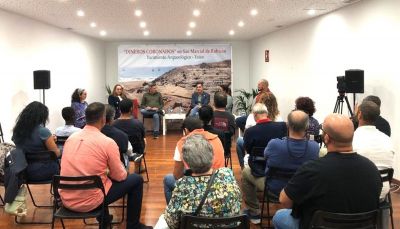
This was announced by the scientific directors of the project, archaeologists María del Cristo González and Esther Chávez, in the streaming colloquium of scientific dissemination on research experiences and advances in this historical enclave held this Wednesday at the Casa del Camello de Uga, where the Director of Cultural Heritage of the regional government, Miguel Ángel Clavijo, confirmed that he shares Yaiza's proposal to condition the site to create an archaeological park that "facilitates its controlled visit."
The institutions and the two public universities committed to this ambitious project intend to further enhance and disseminate the heritage importance of this historical enclave, the first European settlement in the Canary Islands in the 15th century, through a figure that will not "only help its conservation but also boost Yaiza's projection as a cultural municipality."
Since before the start of the first phase of research, recalls Mayor Óscar Noda, "we proposed converting the Rubicón site into an archaeological park so that the population can learn about, be interested in, contemplate, and enjoy an incalculable heritage value in an open space, and I am convinced and aware of the willingness of the Director of Cultural Heritage to work on the design of a low-impact intervention project that will lead us to materialize the San Marcial de Rubicón Archaeological Park."
The streaming promoted by Yaiza also included the restorer of the Museo y Parque Arqueológico Cueva Pintada de Gran Canaria, Patricia Prieto, who outlined her fieldwork at the site from the moment of the discovery of bone remains of ten people and their treatment in situ and that of nine coins from the time until the transfer of all these pieces for analysis in the laboratory.
An exciting and incredible account of the story of the boy of Senegalese origin, Maniang Mbengue (13 years old), protagonist of the casual discovery on November 8 of an ancient coin during a school visit of the CEO Playa Blanca to the site by 'Senderismo Lanzarote'. The visit was linked to the project 'Environmental workshops for the citizens of the municipality of Yaiza', promoted by the city council to promote among the youngest the knowledge of the cultural, landscape and environmental heritage of the south.
The fourth-year ESO student, a resident of Playa Blanca, told the story of the discovery of the coin and his reaction and that of his classmates to such a surprise. The head of Senderismo Lanzarote, Nacho Romero, valued the boy's act of sensibility in informing his teacher of the discovery of the coin, which was handed over this Wednesday to the research management by the Councilor for Heritage of Yaiza, Silvia Santana.
The Yaiza conversation moderated by journalist Alex Salebe gave a lot to know, to know the "illusion" that awakens among the two scientific directors the evolution of their work, the method of the "multidisciplinary team" that they lead and their performance from sun to sun in Los Ajaches and the value they give especially to the coins found at the end of 2021 and also to the casual discovery of the coin of the CEO student. Apart, of course, from the bone remains, habitats, pieces of pottery of aboriginal and colonial origin and all the information that together describe these pieces about the social relations of more than 600 years ago and the environment in which its inhabitants lived.
The coins found in the Rubicón are the oldest in Lanzarote in an archaeological context and it is a unique discovery because eight of the nine pieces bear a countermark representing a Gothic letter 'B', and the royalty granted the Franco-Norman conqueror Jean de Bethencourt the power to mint coins. The fact is relevant for numismatics because there are not many examples of this practice dated from that time.
The Yaiza City Council appreciates the interest of the population in knowing the history and heritage and reiterates the "great work" carried out by the team in charge of the exploration in the Rubicón and its capacity for dissemination in a language aimed at a non-specialist public.


