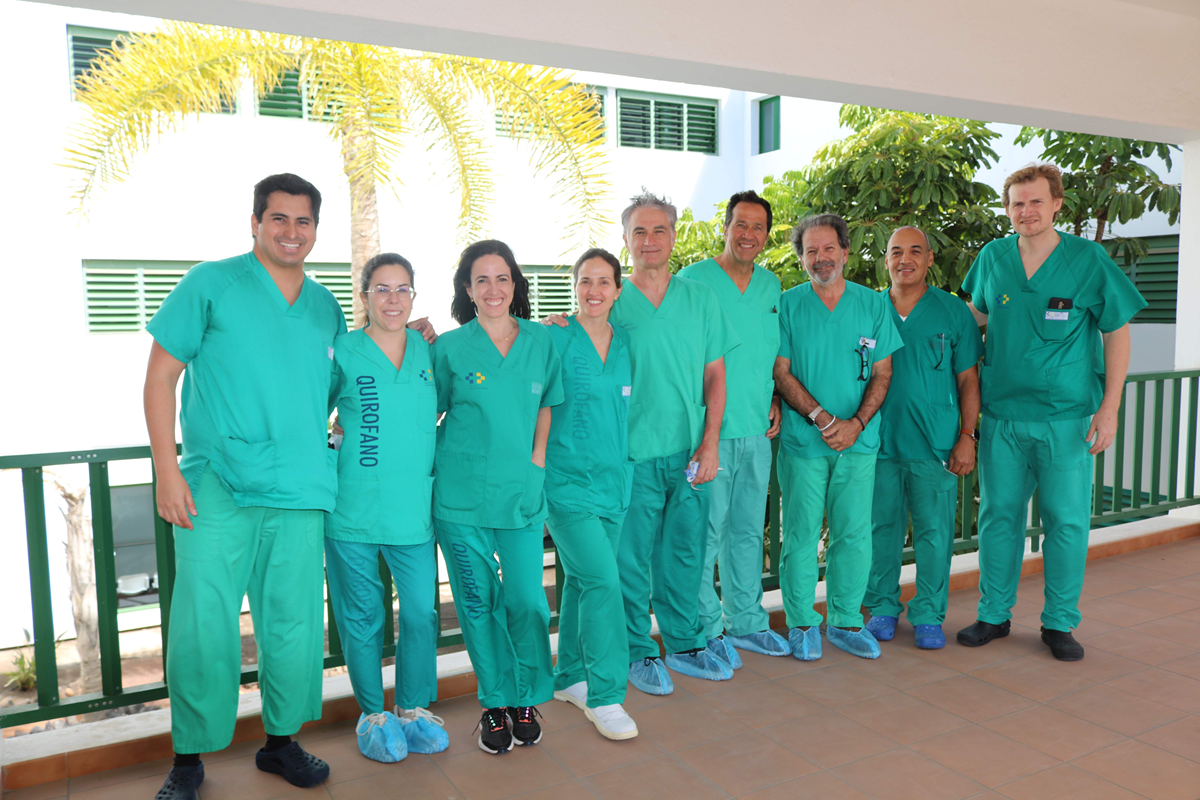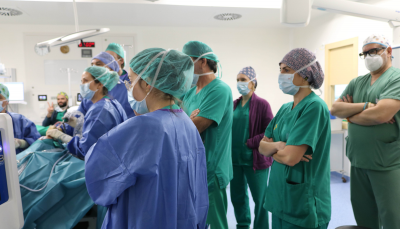
The Otorhinolaryngology service of the Doctor José Molina Orosa University Hospital, attached to the Ministry of Health of the Government of the Canary Islands, has performed three endoscopic interventions assisted by navigator with the collaboration of two specialists in Endoscopic Nasosinusal Surgery of the Hospital de la Santa Creu i Sant Pau and the Hospital Del Mar, both from Barcelona.
These are novel surgical interventions performed with a technology of great precision and efficacy that allows a minimally invasive approach. Precisely, due to these characteristics, the head of the Otorhinolaryngology service of the Molina Orosa Hospital, Antonio Martel, and a team of specialists from the center, supported by specialists from the Doctor Negrín University Hospital of Gran Canaria, were present at the operations and followed the technique with attention.
The otolaryngologist Juan Ramón Gras, specialist in Endoscopic Nasosinusal and Skull Base Surgery of the Hospital de la Santa Creu i Sant Pau, and Dr. María Martel, of the Hospital Del Mar, performed two types of surgery that had not been performed in Lanzarote until now.
The first of these is a Frontal sinus surgery in a patient with a bone tumor with chronic rhinosinusitis that was approached entirely through the nasal fossa with the guide of the navigator.
On the other hand, a lacrimal pathway surgery was carried out in a patient with epiphora due to obstruction of the pathway. In this case, an endoscopic endonasal dacryocystorhinostomy was performed, whose main advantage is that it avoids external incisions and scars, and allows a prompt recovery of the patients, as well as a favorable evolution. In this surgery, Dr. Zapata, an ophthalmology specialist from Molina Orosa, also collaborated.
Endoscopic surgery
Navigator-assisted endoscopic surgery involves an advanced technology that presents important advantages for the patient, since it allows access to the area to intervene without any external incision, which causes less pain and greater comfort, as well as a better postoperative recovery. The intervened patients presented a good evolution and were discharged in 24 hours.
This type of intervention is carried out within the Alive project, designed by Medtronic for the incorporation of hospital centers to the navigator-assisted endoscopic techniques of the nasal fossae and skull base. The project, in which hospitals from all over the country participate, contemplates the training of doctors in this type of surgical approach by reputable professionals.
Both the head of the Otorhinolaryngology service of Molina Orosa and Negrín agree in pointing out that assisted navigation allows the surgeon to observe the anatomical structures on the screen of the equipment at all times, which allows a surgery of great precision, which avoids damaging or injuring the surrounding parts.
Likewise, they emphasize that it is a technology that “provides safety and efficacy in the surgical approach, because the assisted navigation equipment contemplates a double monitoring and, since they show the anatomical images of the patient, it allows the surgeon to support and guide himself through them with millimeter precision”.