
Photos: Sergio Betancort
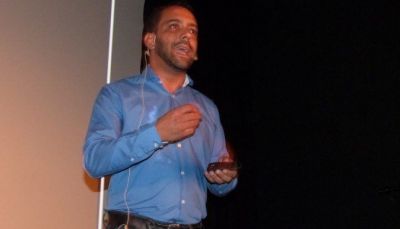
The teacher and researcher of the literary heritage of Lanzarote, Zebensuí Rodríguez Álvarez, on the night of last Tuesday the 14th made a suggestive approach to the emblematic novel ‘Mararía’ by the Tenerife writer Rafael Arozarena. This is the text in which the island landscape acquires a deep meaning associated with the story of a silent, mysterious and beautiful woman, a true metaphor for the island of Lanzarote.
Zebensuí Rodríguez was very supported by fellow teachers, students and friends who filled the capacity of the cinema room of the Cultural Innovation Center ‘El Almacen’. For an hour Zebensuí explained to all those present how Arozarena's first contact with Lanzarote was and how he merged the beauty of the island with that of the character that gave him so much popularity, Mararía. The novel was published in 1973 and was written by its author in 1940, although five years later he made some corrections.
During the development of the presentation Zebensuí insisted on something that many of those born in Lanzarote in the decade of the eruptions and until not many years ago described the island with the most negative qualifiers such as "surviving with more than three quarters buried by the volcanoes, the scarcity of water and a desolate landscape". Also Benito Pérez Armas, in one of his books, described Lanzarote as a "coffin wrapped in black crepe paper".
Landscapes
And as Zebensuí explained well, the native of Lanzarote gradually became aware and began to love his island more when listening to the visitors who arrived over the years and who spoke wonders of the landscapes they had in front of them. That landscape was also what conquered Rafael Arozarena and inspired him to write the famous novel Mararía where he merges island and woman, a woman of whom all the characters that appear in the novel speak of her, all describe her as a very beautiful woman, tall with large eyes and always covered in her clothes for fear of being seduced. Everyone talks about her but she never spoke in the novel and, as Zebensuí said, there the metaphor is very present again: "Lanzarote island does not speak either". And it is that Arozarena described the island at the same time as the character.
The audience followed the entire presentation very attentively and even found it short since the speaker, in addition to being a historian and heritage researcher, has a gift of the word that easily reaches everyone. With a great ovation he said goodbye and with a message to take into account: "Lanzarote our island does not speak, we will be the ones who will have to speak before the new Land Law and the installation of the electric towers that they want to install from Mácher to Playa Blanca"
This presentation by Zebensuí Rodríguez is linked to the exhibition that was inaugurated on February 17 entitled ‘Five women in search of Arozarena’, in which five women linked to the island participate, such as Margarita Amar, Mariola Acosta, Macarena Nieves Cáceres, Ángeles García Perera and Rosa Vera. All of them make a special plastic approach to the literary universe of the novel Mararía.


