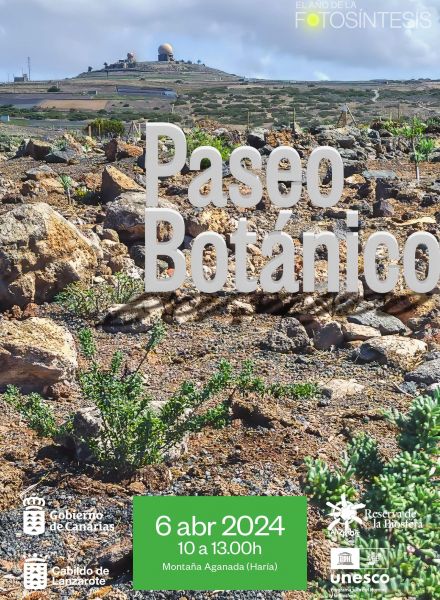
The Biosphere Reserve office of the Cabildo of Lanzarote has organized a botanical walk through Montaña Aganada with the aim of learning about the experimental project that aims to restore habitats on the summit of Famara. This initiative, promoted by the Government of the Canary Islands since 2020, is co-financed by the European Regional Development Fund.
The departure will take place next Saturday, April 6, between 10:00 a.m. and 1:00 p.m., and the meeting point will be El Bosquecillo de Haría. To access the places, it will be necessary to complete a registration form through the link https://forms.gle/PRKPo3jbAst96EgL7. Attendance will be confirmed in strict order of application.
This activity, implemented within the framework of the PHOTOSYNTHESIS 2024 program, will be guided and interpreted by the researcher and botanist, director of the Jardín de Aclimatación de La Orotova, Jorge Alfredo Reyes Betancort, the edaphologist and professor at the University of La Laguna, Francisco Javier Díaz Peña, and the biologist, technician of the Biodiversity service of the Regional Executive, Sofía Rodríguez Núñez.
The president of the Cabildo, Oswaldo Betancort, has thanked the Government of the Canary Islands, the EVA 22 Air Surveillance Squadron of the Ministry of Defense, the University of La Laguna, the Canarian Institute of Agricultural Research and the Teguise Secondary Education Institute, together with the collaborating public and private companies, for the coordination effort and networking that has made it possible to launch this experimental project, of enormous environmental relevance.
Famara, treasure of biodiversity
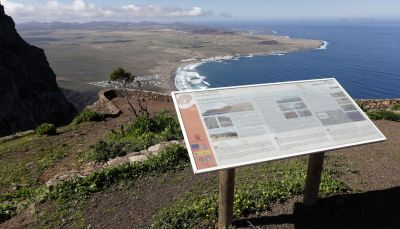
The Famara massif constitutes an authentic treasure for the biodiversity of the island of Lanzarote, with a peculiar microclimate that allows the development of fogs during a large part of the year and promotes the development of unique plant communities in the area. In this enclave, more than 350 endemic species of the Canary Islands are concentrated, of which 81 are exclusive to Lanzarote; in the past, the presence of elements of the monteverde such as fayas and heathers was verified.
However, the anthropic use of the territory, the action of introduced herbivores, especially rabbits and feral livestock, as well as the desertification processes that have taken place in recent decades, have led not only to a significant deterioration of their habitats but also to a notable loss of soil.
After many failed initiatives by different administrations to try to restore the original vegetation, the Government of the Canary Islands launched an experimental project based on soil health, in which experimental plots have been established to test new methodologies to be implemented in habitat restoration work.
Among the most important actions, the establishment of orchards whose production guarantees the availability of seminal material stands out, even in unfavorable climatic conditions; the enrichment of the soil microbiota; the development of mechanisms to prevent erosion; the implementation of water infiltration systems in the deep layers of the soil; the planting of approximately 8,000 specimens of flora of 40 different species, as well as dissemination actions among the educational community and the different social groups of Lanzarote.